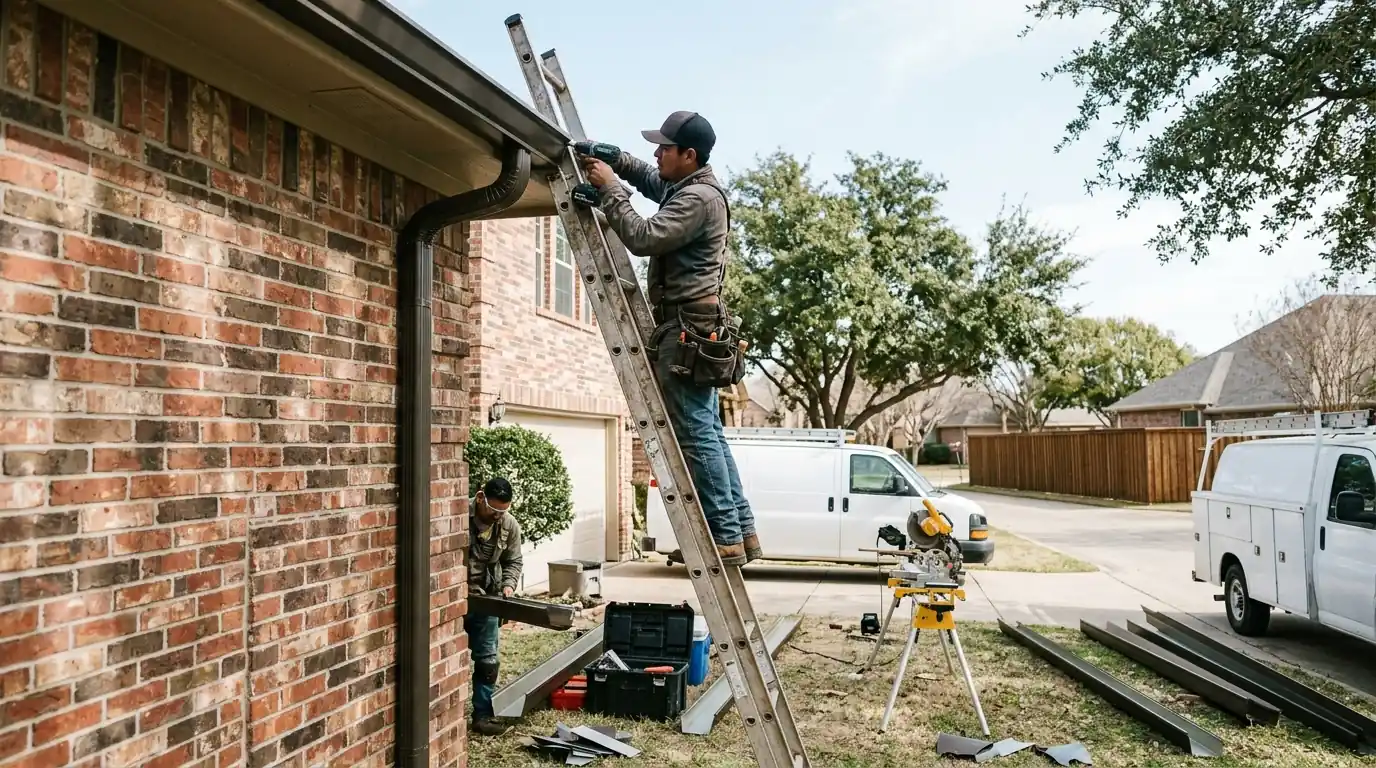
Short answer. Commercial gutter installation in Dallas usually means oversized K-style or box gutters with large rectangular downspouts, sized to the roof area each run drains. We plan access, lifts and work hours around tenants and customers, and we coordinate with roofers on new builds and re-roofs.
How commercial jobs differ
The metal is the same family as residential work, just bigger: wider troughs, heavier gauges, larger downspouts and more of them. What really changes is the planning. Lifts need room, walkways need protecting, and the work happens around a business that is open.
Many commercial roofs drain to the edge through scuppers, so the gutter work often includes the collector boxes and downspouts below them. That is covered on our scupper and conductor head page.
Residential gutters compared with commercial
| Typical home | Commercial building | |
|---|---|---|
| Profile | 5 or 6-inch K-style | Oversized K-style or box |
| Downspouts | 2x3 or 3x4 | Larger rectangular, more of them |
| Access | Ladders | Lifts, often after hours |
| Discharge | Extensions or yard drains | Storm drains, basins, splash pads |
What drives the cost of commercial gutters
Commercial jobs are priced from a site walk, since access and size vary so much.
- 1Linear footage
Total length of trough and downspouts.
- 2Profile and gauge
Larger and heavier metal costs more.
- 3Lift access
Lift rental and setup time.
- 4Work hours
After-hours work to avoid tenants.
- 5Tie-ins
Connecting downspouts to storm drains or basins.
7-inch and box profiles
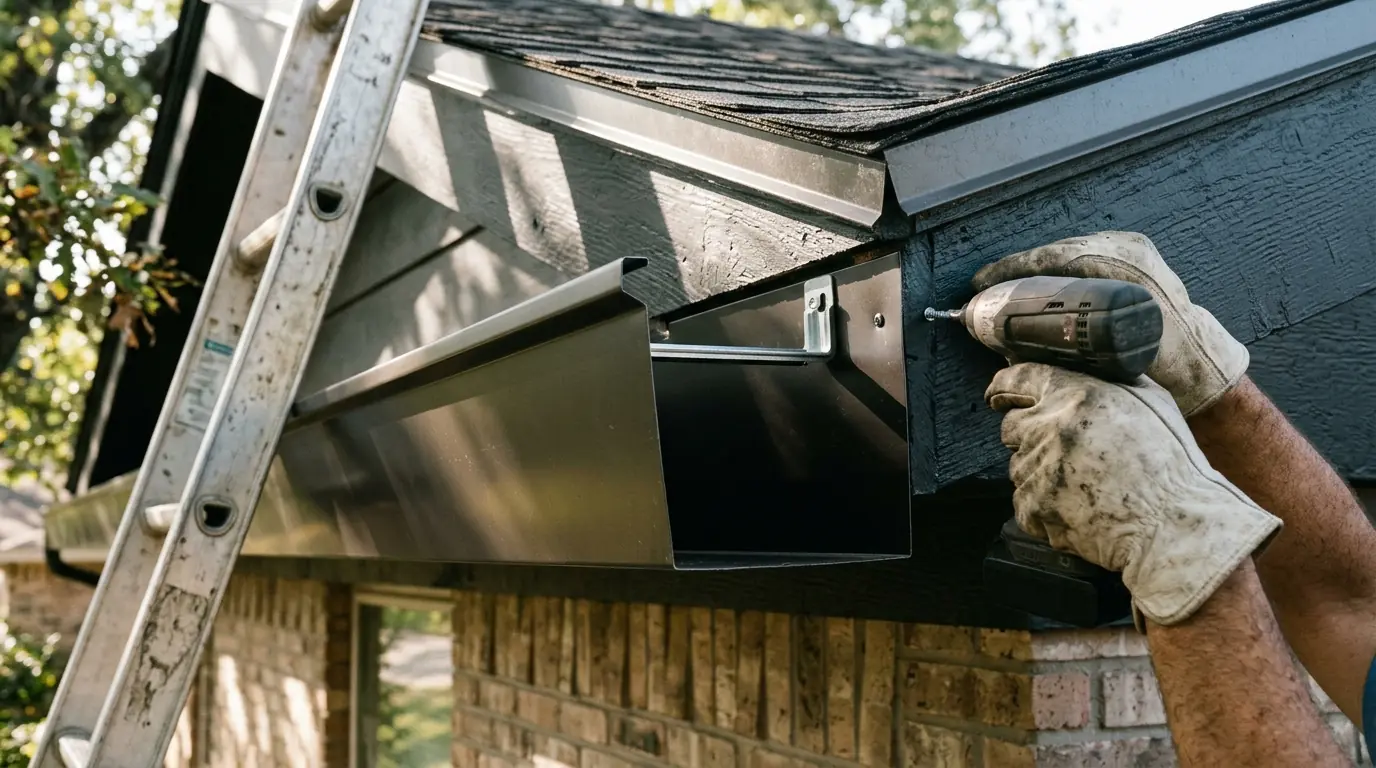
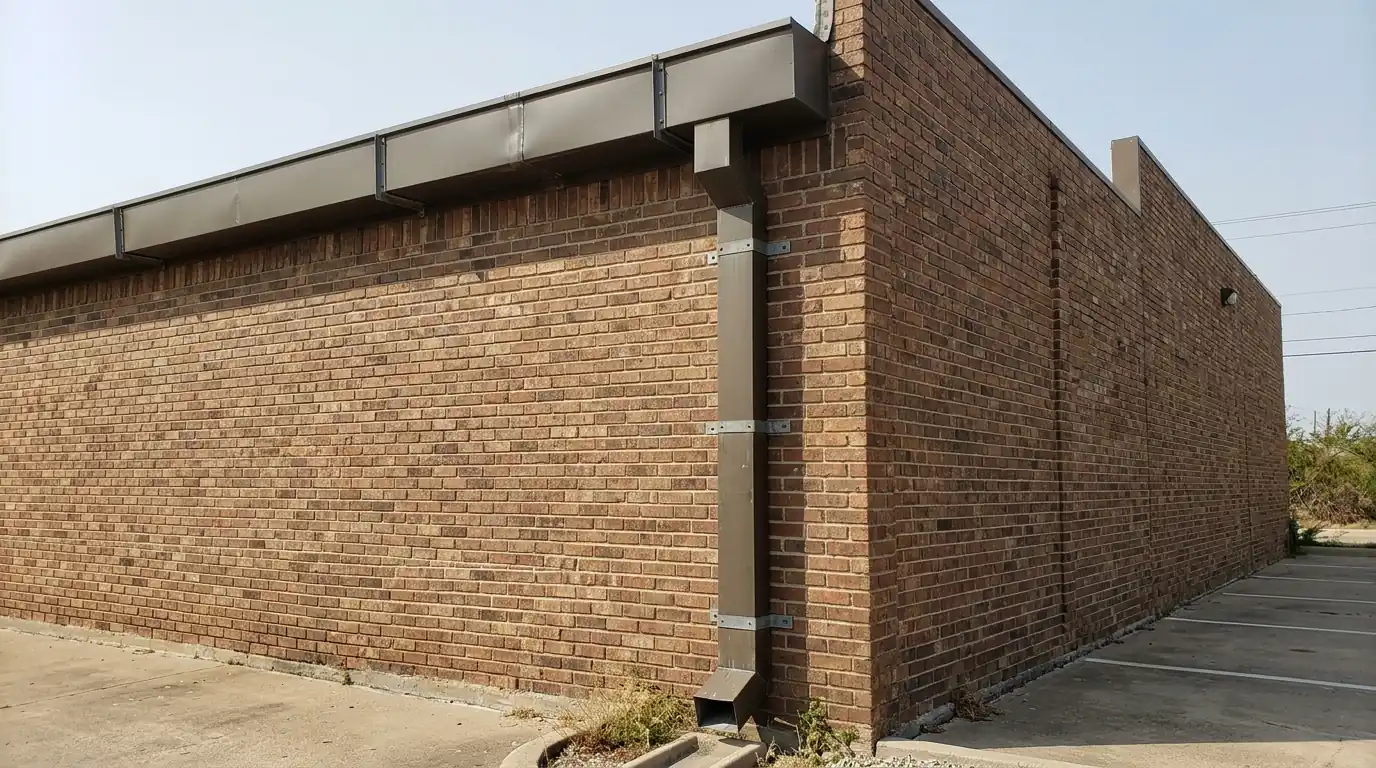
Large roof planes need more trough than a 6-inch residential gutter offers. We install oversized K-style and box profiles sized to the roof area each run drains, with hangers spaced and gauged for the weight. Box gutters suit flat-front commercial facades where a molded K-style front would look out of place.
Large downspouts
Commercial runs usually need larger rectangular downspouts, and more of them, so water leaves the roof as fast as it arrives. We place them where the site can take the discharge, into storm drains, catch basins or splash pads, and away from entrances and sidewalks where customers walk.
Lift and access plans
Most commercial work is done from lifts rather than ladders. We plan where the lift can sit, how walkways and parking are blocked off, and when the work is least disruptive, then share that plan with the property manager before we arrive.
Working around tenants
Offices, shops and churches stay open while we work. We schedule noisy work outside busy hours where we can, keep entrances clear and safe, and clean up each day rather than leaving material on site overnight.
Brands and product lines we install
Brands and product lines we install: Englert, Senox, Berger, OmniMax, Klauer, Mueller, Spectra, Gutterglove, MasterShield, Raptor, Flex-A-Spout, NDS, ADS, Zurn.
Commercial runs use coil and fittings from makers such as Mueller and Englert, with roof drains and scupper parts from suppliers like Zurn.
What a commercial installation includes
- Roof area measured for each run
- Profile and downspout size chosen to match
- An access and safety plan for the site
- Hangers gauged for the heavier trough
- Downspouts tied into site drainage
- Daily clean-up of the work area
- A water test of every run before sign-off
Commercial gutter materials in Dallas
Dallas suppliers stock seamless gutter coil in aluminum, copper and Galvalume, so commercial runs can be formed to length rather than pieced together from short sections. That matters on long commercial facades, where every joint is a future leak. We choose the metal for the building: aluminum for most offices and retail, Galvalume where a metal roof or heavier hail exposure calls for it.
How a commercial job runs
Site walk
Roof, drainage, access and hours reviewed with the manager.
Plan and schedule
Lift placement, safety zones and work windows agreed.
Remove old runs
Old gutters taken down in sections.
Install
New runs, hangers and downspouts set and sealed.
Test and hand over
Water test, clean-up and photos for the file.
Commercial gutter questions
Yes. We plan access and hours around tenants and keep entrances safe.
Yes, where the site allows it, to keep disruption down.
It depends on the roof area each run drains. We size every run separately.
Yes, on new builds and re-roofs, so the drip edge and gutters work together.
Yes, where the site has drains or catch basins to receive them.
Yes, on flat and parapet roofs.