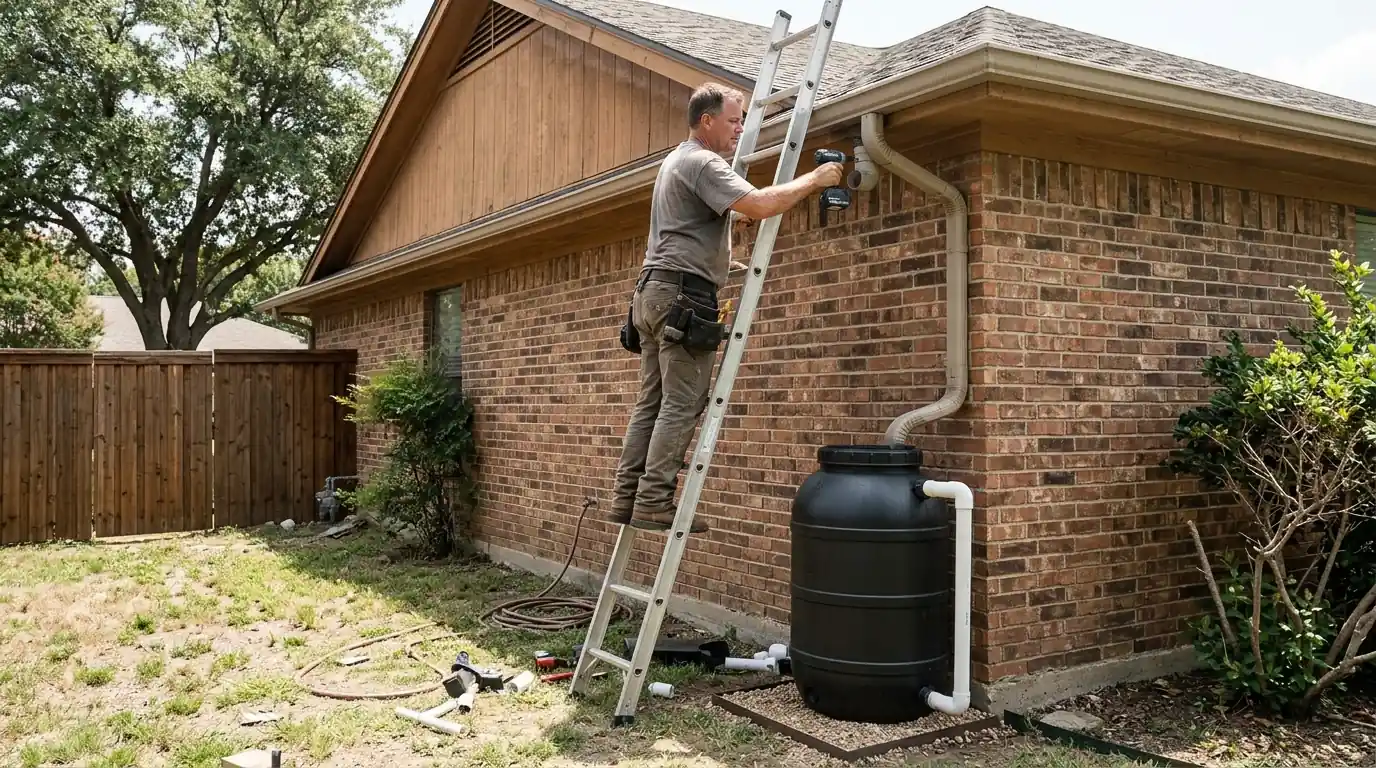
Short answer. Rainwater harvesting in Dallas usually starts with one or two rain barrels on downspouts near the garden, connected through a diverter so the barrel fills and the rest of the water still drains. In Texas, an HOA cannot prohibit rain barrels or a rainwater system, though it can regulate where they sit and how they look.
What a rain barrel setup involves
A barrel under a downspout is the simple version. The useful version adds a diverter that fills the barrel and sends the rest down the downspout, a screen that keeps leaves and mosquitoes out, and an overflow that does not dump water against the house when the barrel is full.
Bigger systems use linked barrels or a cistern, sized to the roof and the garden. We plan them with the gutters in mind: a barrel on a downspout that drains a valley fills in minutes, while one on a small porch roof barely fills at all. Clean gutters matter more here than anywhere, since what is in the gutter ends up in the barrel.
Barrel, linked barrels or cistern?
| Single barrel | Linked barrels | Cistern | |
|---|---|---|---|
| Holds | One barrel's worth | Two or three barrels | Hundreds to thousands of gallons |
| Space needed | A corner by the downspout | A short wall section | A pad and room for a tank |
| Best for | Pots and a small bed | A vegetable garden | Larger beds and lawns |
| Extra parts | Diverter, screen | Linking kit, overflow | Pad, overflow, often a pump |
What changes the cost of a rainwater setup
We have no sourced Dallas price range for these systems, so here is what moves the number.
- 1Storage size
One barrel is simple; a cistern is a project.
- 2Base and pad
A full barrel or tank needs a firm, level base.
- 3Diverters and screens
First-flush diverters and fine screens add parts.
- 4Overflow route
Extensions are simple; buried overflow lines cost more.
- 5Pump
Pressure for a hose or drip system needs a pump.
Rain barrels
A single barrel, usually 50 to 65 gallons, sits on a raised stand so a hose or watering can fits under the spigot. We set it on a level, solid base, since a full barrel weighs several hundred pounds, connect it through a diverter, and fit a fine screen over every opening to keep mosquitoes out.
Linked barrels and cisterns
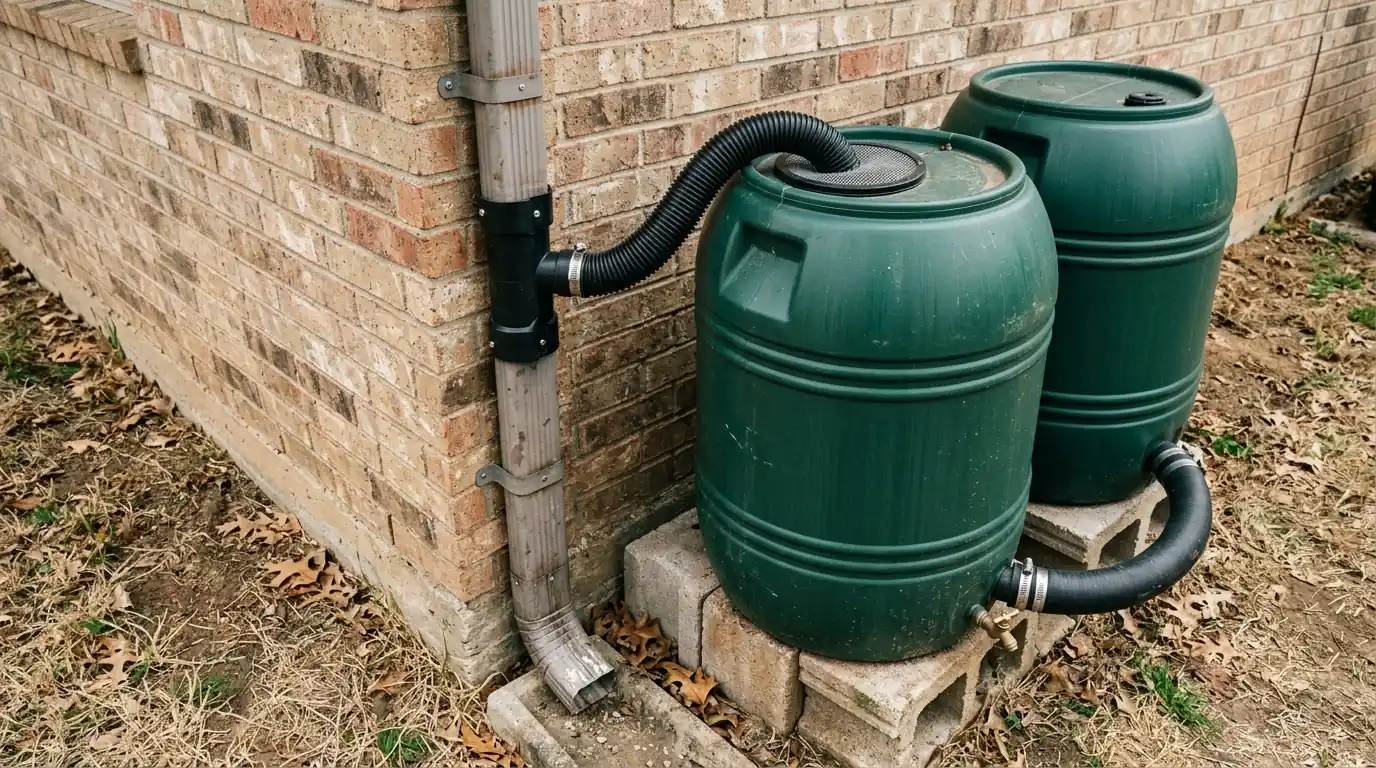
Two or three barrels linked at the base fill and drain together. Beyond that, a cistern holds hundreds or thousands of gallons in one tank. Cisterns need a firm pad, a planned overflow and, if you want pressure for a hose, a pump. We size them to the roof area that feeds them and to what you plan to water.
First-flush diverters
The first rain off a roof carries dust, pollen and grit. A first-flush diverter catches that first slug of water and sends it away before the barrel starts filling, which keeps the stored water cleaner. It is a small part that makes a big difference on Dallas roofs in pollen season.
Overflow routing
When the barrel is full, the water still needs to leave the house. We route overflow back into the downspout, onto an extension, or into a buried line, so a full barrel never becomes a fountain beside the slab.
Rain barrels under Texas rules
Texas makes rain barrels easy to justify. Under Texas Property Code section 202.007 a property owners association cannot prohibit rain barrels or a rainwater harvesting system, though it can set rules on placement and appearance, and Texas Tax Code section 151.355 exempts rainwater harvesting equipment from state sales tax. With Dallas averaging about 37 inches of rain a year, a roof fills a barrel quickly in the wet months.
Setting up a barrel yourself
Easy to do yourself
- A single barrel with a diverter kit on a ground-floor downspout
- Screening openings against mosquitoes
- Draining the barrel before a freeze
Worth calling us
- Cisterns and pumps
- Cutting downspouts on brick or two-story homes
- Routing overflow underground
How a rainwater setup goes in
Pick the downspout
One that drains enough roof and sits near the garden.
Set the base
A level, solid stand or pad.
Fit the diverter
The downspout is cut and the diverter installed.
Connect and screen
Barrel or cistern connected, openings screened.
Route the overflow
Overflow sent back to the downspout or away from the slab.
Rain barrel questions
Under Texas Property Code 202.007, an HOA cannot prohibit rain barrels, though it can regulate where they go and how they look.
Texas Tax Code 151.355 exempts rainwater harvesting equipment from state sales tax.
Not if every opening is screened and the barrel is used or drained regularly.
In a heavy Dallas storm, a barrel on a busy downspout can fill in minutes.
We install barrels for garden use. Drinking water needs treatment beyond what we provide.
The diverter sends the rest down the downspout, or the overflow goes to an extension or buried line.