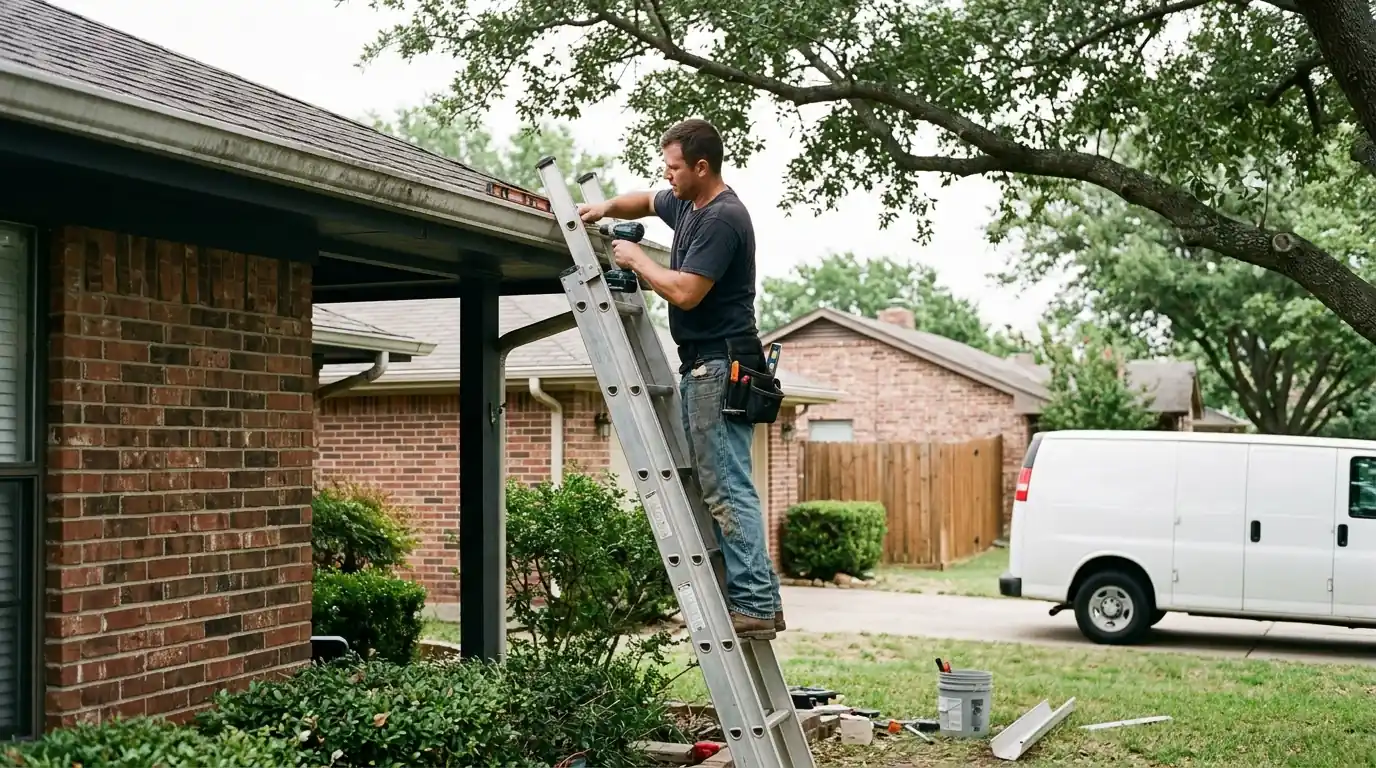
Short answer. Gutter slope correction in Dallas means taking down the hangers on a run, re-snapping a line with the right fall, about a quarter inch per 10 feet toward the outlet, and rehanging the gutter to it. Long runs are often split to drain both ways. Most corrections take a few hours per run.
Why gutters lose their pitch
Some gutters were hung flat from day one. Others start right and drift: hangers loosen, the fascia warps, or the house itself moves. Either way water ends up sitting in the trough instead of reaching the downspout, and standing water adds weight, rots leaves into sludge and rusts steel.
Correcting slope is a rehang, not a patch. We reset the line, then rehang on new hidden hangers. If the run sags because the board behind it is soft, that is a fascia repair first, or the new pitch will not last.
What decides the cost of slope correction
We have no sourced price range for slope correction, so here is what moves the number.
- 1Length of the run
A longer run means more hangers to reset.
- 2Splitting the run
Adding a center outlet and downspout adds parts.
- 3Moving an outlet
Cutting a new outlet and capping the old one takes time.
- 4Fascia condition
Soft boards need repair before rehanging.
- 5Height
Second-story runs need more setup.
Standing water
If water is still sitting in the gutter a day after rain, the run is flat or dips in the middle. We check it with a level and a hose, mark where it holds water, and reset the hangers so the whole run falls to the outlet. Pooled water is also where mosquitoes breed in a Dallas summer, so it is worth fixing even when it is not overflowing.
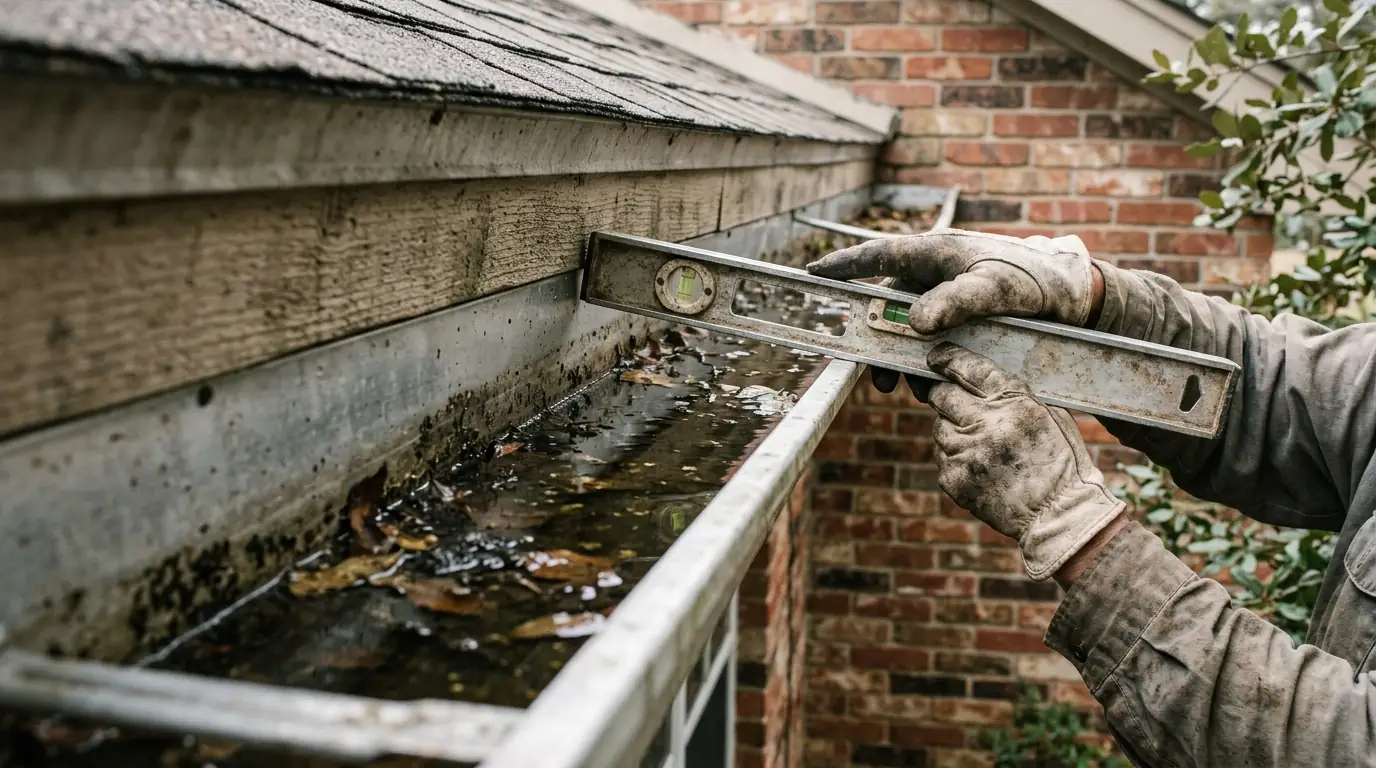
Backfall toward the wrong end
Sometimes a run slopes away from its downspout, so water flows to the closed end cap and spills there. That is common after a gutter was rehung by eye. We reset the fall toward the outlet, or, if the downspout is in the wrong place, move the outlet to the low end instead.
Long runs split to two outlets
On a long eave, a single fall to one end means the far end of the gutter sits high above the fascia line, which looks wrong and leaves a gap. We split long runs at the middle so each half falls toward its own downspout. It drains faster in a storm and keeps the gutter close to the roof edge.
Settled houses
Houses on moving soil shift, and a gutter that was pitched correctly years ago can end up flat or reversed. We set the new pitch from a fresh line rather than following the old hangers, so the gutter drains even if the house is no longer perfectly level.
Why Dallas gutters drift out of pitch
Dallas soils are mostly clay, much of it Houston Black clay, and foundations on that clay shift and settle over the years. When a house moves even slightly, a gutter hung to follow the old fascia line can end up flat or tipped the wrong way. That is why we snap a fresh line for the fall rather than trusting the old hangers.
What you can check before calling
Easy to check yourself
- Run a hose at the high end and watch where water stops
- Look along the gutter line from the yard for dips
- Note which end spills during storms
Leave the rehang to us
- Resetting hangers along a full run
- Moving an outlet to the low end
- Any second-story run
Signs your gutter pitch is off
- Water still in the trough
Standing water a day or more after rain.
- Overflow at the wrong end
Spills at the end cap instead of the downspout end.
- A visible dip
The gutter line sags in the middle of the run.
- Mosquitoes near the eaves
Larvae breeding in water held in the gutter.
- Sludge lines
Dark rings on the inside where water sits and dries.
How we correct gutter slope
Test with water
A hose shows exactly where water stops.
Snap a new line
A chalk line with the right fall to the outlet.
Reset hangers
Old hangers out, new hidden hangers to the line.
Adjust outlets
Split long runs or move outlets if needed.
Test again
Water runs clear to the downspout before we leave.
Gutter slope questions
About a quarter inch of fall per 10 feet toward the outlet is the common rule. Too much looks crooked; too little holds water.
Usually. If the gutter itself is straight and sound, rehanging it at the right pitch fixes the problem.
It is pitched the wrong way. We reset the fall or move the outlet.
On long runs, yes. Splitting the fall to two outlets drains faster and keeps the gutter tight to the roof.
Yes. It adds weight to hangers, rots debris into sludge and gives mosquitoes a place to breed.
A few hours per run in most cases.