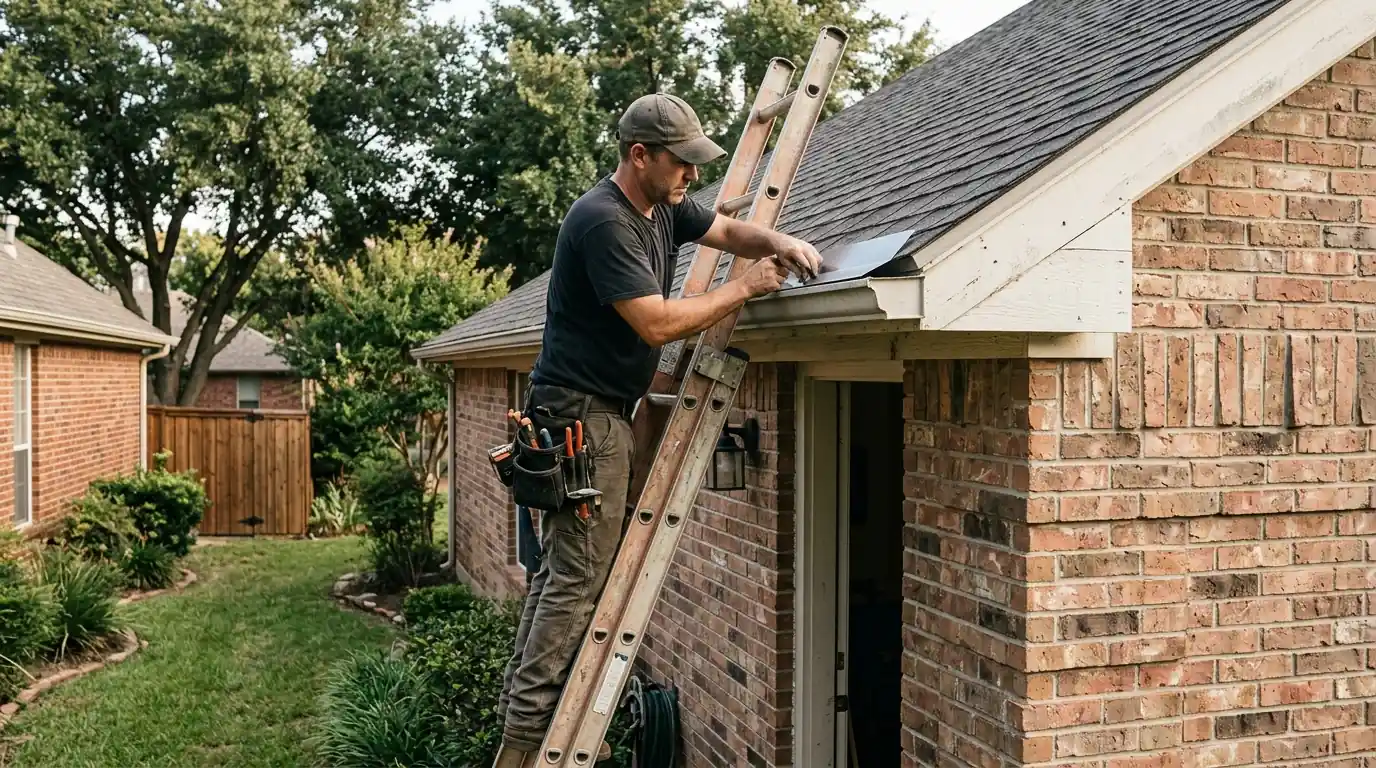
Short answer. Rain diverters in Dallas are short angled strips of metal installed on the roof to steer water away from a doorway or toward a gutter, and kickout flashing turns water away from a wall where a roof edge meets siding. They suit spots where a full gutter would be awkward, but they are not a replacement for gutters on a whole roof.
Where diverters help
A diverter is useful where water collects in one stream and lands somewhere it should not: on the front step, a stoop with no gutter, or a walkway beside the house. A short strip slid under the shingles above the door splits or redirects that stream.
They have limits. A diverter moves water sideways; it does not carry it away. On a large roof, or where the water simply moves to the next door down, a proper gutter run with a downspout and extension is the better answer, and we will tell you so.
Diverter, kickout or gutter?
| Rain diverter | Kickout flashing | Short gutter run | |
|---|---|---|---|
| Fixes | Water landing on a doorway | Water running down a wall | Water anywhere along an edge |
| Carries water away | No, moves it sideways | No, sends it to the gutter | Yes, to a downspout |
| Visibility | Small, on the roof | Small, at the wall | Visible run and downspout |
| Best when | A gutter would look odd | Roof meets a wall | There is room for a downspout |
What changes the cost of a diverter
We have no sourced price range for diverters and kickouts, so these are the factors that set yours.
- 1Roof type
Lifting shingles takes care; tile and metal roofs take more.
- 2Location
Over a door versus at a valley or wall.
- 3Height
Upper roofs need more setup.
- 4Existing damage
Rotted siding or trim behind a missing kickout.
- 5Number of spots
Several diverters in one visit cost less per spot.
Roof valley diverters
Two roof planes meeting in a valley send a concentrated stream of water down to one point. If that point is over a walkway or the gutter is too small to catch it, the water shoots over. A diverter near the bottom of the valley, or a splash guard on the gutter below, keeps it in the system.
Over entry doors
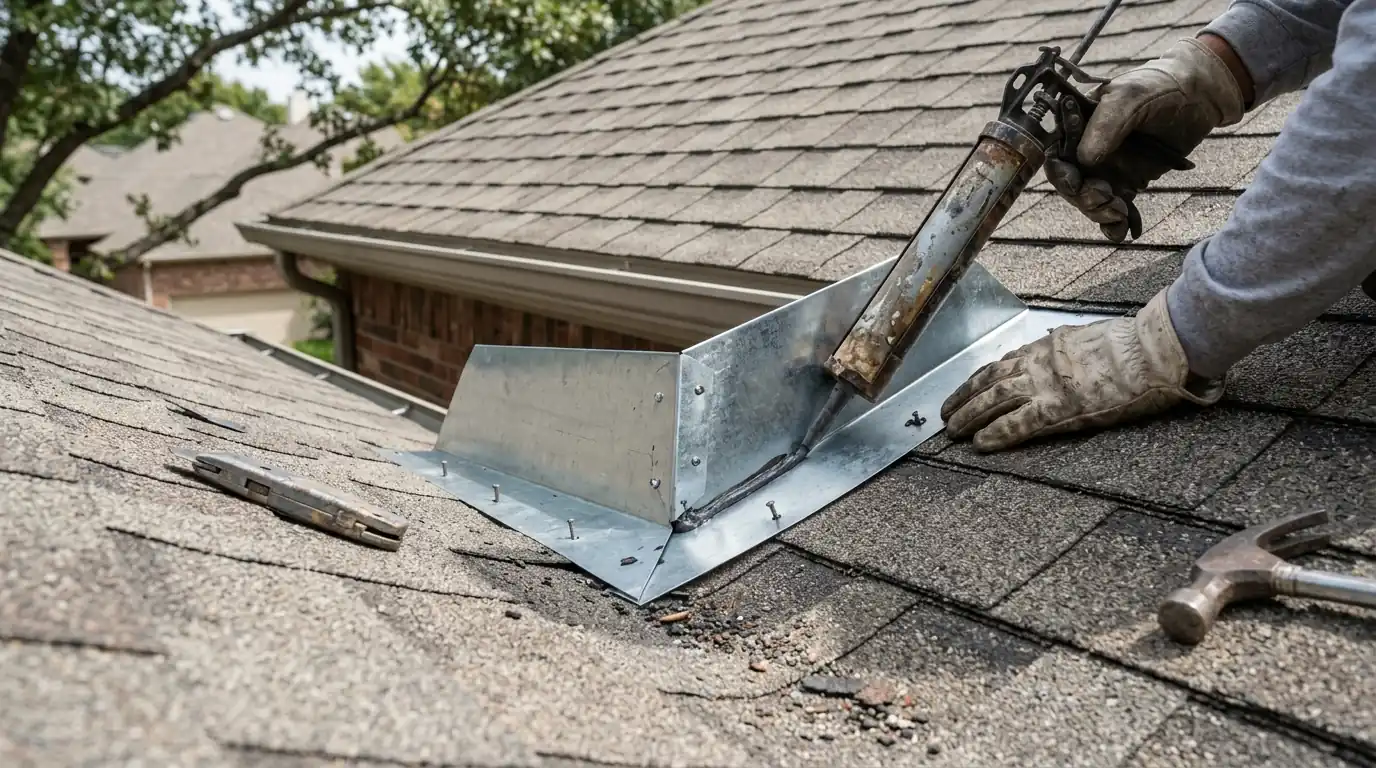
Entries without a gutter overhead get a curtain of water in every storm. A diverter installed in the roof above the door sends the water to either side, so you are not stepping through it. We seal it under the shingles carefully, since a badly set diverter can let water into the roof.
Kickout flashing
Where a roof edge ends against a wall, such as a garage roof meeting the side of a two-story house, water runs down the wall instead of into the gutter. Kickout flashing is a small angled piece that kicks that water out into the gutter. Missing kickouts are a common cause of rotted siding and stained brick below roof edges.
Where diverters hurt
A diverter is the wrong fix when it just pushes water onto the next problem: a neighbor's walkway, a window well or a flower bed against the foundation. It can also trap debris on the roof above it. If a gutter would work better, we say so instead of selling the cheaper part.
Diverters on steep Dallas rooflines
Diverters and kickouts earn their keep on steep, complicated roofs. In the M Streets, where building began in 1923 and Tudor Revival homes made up most of the neighborhood, steep intersecting gables send water down short valleys right over entries and onto walks. On rooflines like those, a small diverter or a kickout often solves a drip a full gutter could not reach.
Signs you need a diverter or kickout
- A curtain at the door
Water pours off the roof onto the front step.
- Stains on brick
Dark streaks below where a roof meets a wall.
- Rot at siding corners
Soft siding or trim below a roof edge.
- Overflow at one corner
Water shoots off a valley past the gutter.
- Washout in a bed
Soil carved away below a valley.
How a diverter install goes
Watch the water
We look at where it collects and lands.
Pick the fix
Diverter, kickout, splash guard or a short gutter.
Lift and set
Shingles lifted carefully, metal set under them.
Seal
Fasteners and edges sealed against leaks.
Test with a hose
Water run down the roof to check the path.
Rain diverter questions
Only over a small spot like a doorway. For a whole roof edge, a gutter is the right fix.
Not when they are set under the shingles and sealed properly. A badly set one can.
A small angled piece where a roof edge meets a wall, kicking water into the gutter instead of down the wall.
Often yes, with parts and methods suited to that roof.
It can on a roof under heavy trees, which is one reason we sometimes suggest a gutter instead.
Yes, at valleys where water shoots over the front edge.