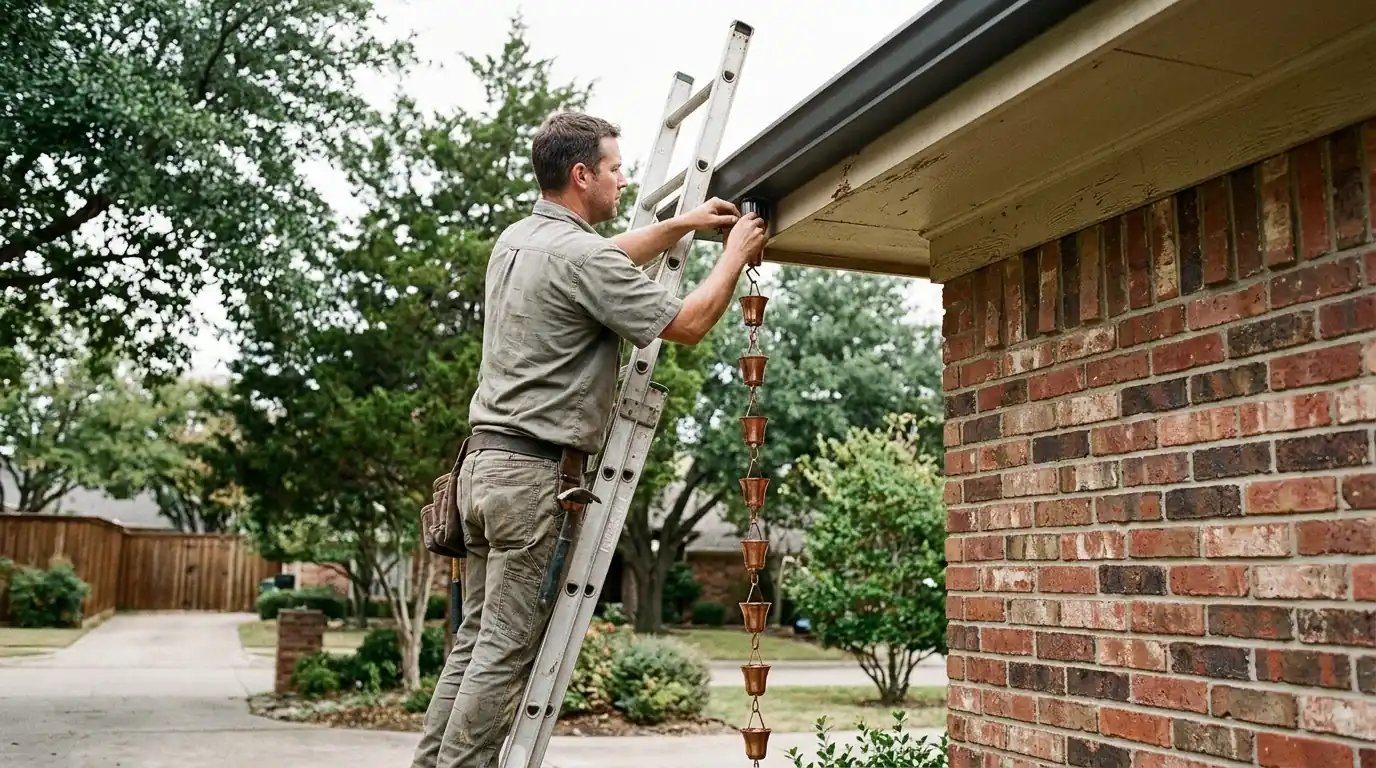
Short answer. A rain chain in Dallas works best on a small roof section, such as a porch or entry, because a single chain carries far less water than a 3x4 downspout during a May storm. We match cup chains to the busier corners, add a ground basin, and keep the main downspouts where the big roof planes drain.
Where a rain chain makes sense
Rain chains are a downspout you can watch. Cups catch and pass water down; plain links let it cling and drip. On a porch roof, a garden shed or an entry over the front walk, one chain handles the flow well and looks better than a crimped aluminum pipe.
On a big two-story plane they struggle. Heavy rain sheets off the outside of the chain and splashes the wall, so we pair chains with a normal downspout elsewhere on the same run when the roof is large.
Rain chain or downspout for this corner?
| Cup chain | Link chain | 3x4 downspout | |
|---|---|---|---|
| Best for | Porches, entries, small roofs | Pergolas, sheds, light flow | Main roof planes and valleys |
| Splash in heavy rain | Some | More | None, water stays inside |
| Look | Decorative, visible flow | Light, decorative | Plain, can be color-matched |
| Ground plan | Basin or drain at the base | Basin or drain at the base | Extension or buried drain |
What changes the price of a rain chain
We have no sourced Dallas price range to quote for rain chains, so here is what moves the number instead.
- 1Chain material and length
Copper costs more than aluminum, and a two-story drop needs a much longer chain.
- 2Cup or link style
Cup chains use more metal than links and usually cost more.
- 3Outlet changes
A new outlet or adapter in the gutter adds a little labor.
- 4What sits at the base
A rock basin is simple; a catch basin piped to a pop-up emitter is a small drainage job.
- 5Removing the old downspout
Taking down and capping the old outlet path is part of the visit.
Cup chains
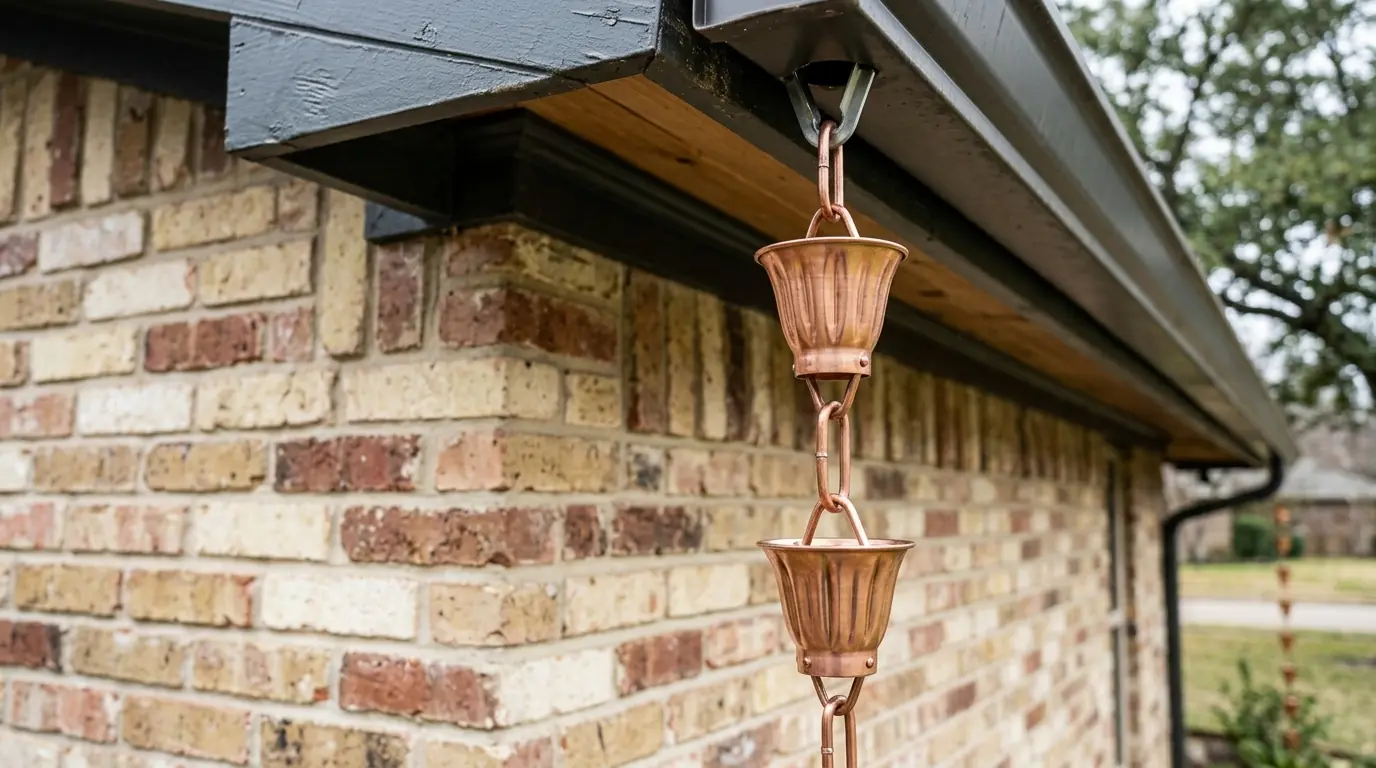
Cup chains are the workhorse. Each cup has an open bottom, so water drops from cup to cup with less splash than links. They handle a moderate porch roof well and they are the version we suggest when the chain hangs near a door or window. Copper cups weather to brown, then green; powder-coated aluminum keeps its color. We hang them from a cup-style outlet adapter so the first drop lands inside the top cup, not beside it.
Link chains
Link chains are lighter and quieter to look at: plain loops, twisted links or decorative shapes. They suit a light flow, like a small entry roof or a pergola, and they move more in wind. Expect more splash than cups when the rain gets heavy, so we keep link chains away from walkways and door thresholds, and we will tell you plainly if the roof above is too big for one.
Ground basins
What happens at the bottom matters more than the chain. A basin of river rock, a decorative bowl or a small catch basin tied into an underground drain keeps the water from digging a hole beside the foundation. On Dallas clay we would rather pipe the basin away than let it soak in against the slab.
Wind and anchoring
North Texas storms swing a loose chain into siding and windows. We anchor the bottom of every chain to the basin or a ground stake with a little slack, so it hangs straight in a gust and still lets water through. If a chain sits in a windy corner, we choose heavier cups that move less.
Rain chains and Dallas downpours
Dallas averages about 37 inches of rain a year, and May alone brings close to 5 inches, often in short heavy bursts. That is the test a rain chain fails if the roof above it is too big. The ground matters as much: the Blackland clay under most Dallas yards swells when soaked, so we put a basin or a buried line under every chain rather than letting it drip onto the soil beside the slab.
Hanging one yourself, and where it goes wrong
Fine to do yourself
- Swap a chain onto an existing outlet on a one-story porch
- Fill a basin with river rock
- Rinse leaves out of the cups after a storm
Worth a call
- Any chain above the first story
- Roofs big enough to overflow a single chain
- Piping the basin away from the slab
How a rain chain install goes
Check the roof above
We look at how much roof drains to that corner and say whether one chain can carry it.
Pick style and finish
Cups or links, copper or aluminum, and the length you need.
Fit the outlet
We set a chain outlet adapter in the gutter and seal it.
Hang and anchor
The chain goes up, then we anchor the bottom with slack.
Sort the base
Rock basin, bowl or a drain tie-in, then we run a hose to test it.
Rain chain questions
Usually not. On a typical Dallas house we keep downspouts on the big roof planes and use chains on porches, entries and small sections.
Some, especially link chains in heavy rain. Cup chains splash less, and a basin at the bottom catches most of it.
Copper weathers to brown and then green and costs more. Powder-coated aluminum keeps its color and is lighter.
Cups can catch leaves and pecan catkins. A gutter guard at the outlet or a quick rinse after storms keeps them flowing.
Yes. We set a small catch basin at the base and pipe it away from the slab like any downspout.
Yes, the phone is answered 24/7, and we can book a visit for the next open day.