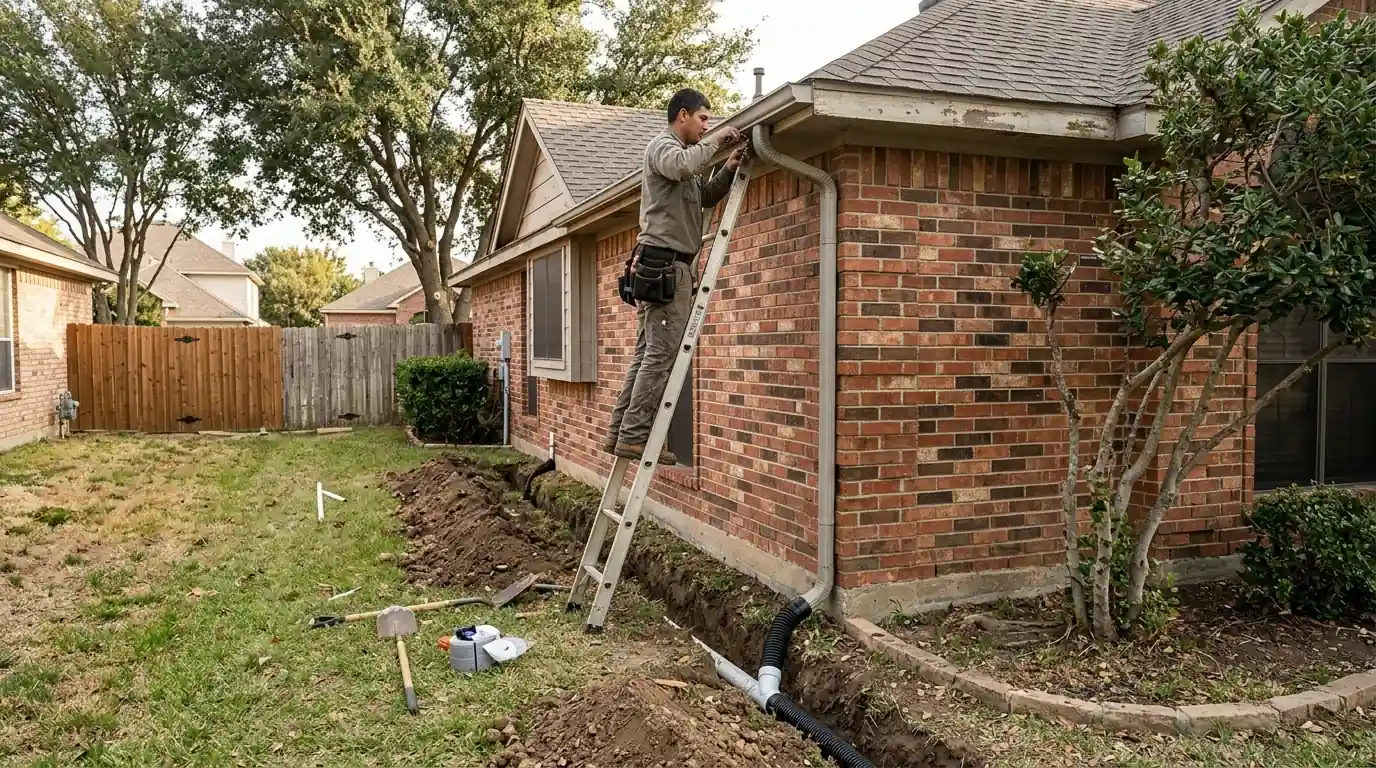
Short answer. An underground downspout drain in Dallas is a buried pipe that carries roof water from the downspout to a pop-up emitter, a curb outlet or a lower part of the yard. A 20 to 40 foot tie-in commonly runs about $200 to $1,400 by national estimates, depending on length, soil and outlet. We add a cleanout so the line can be cleared later.
Why bury the downspout line
Splash blocks and extensions move water a few feet. On a lot with beds against the house, a patio or a driveway, there may be nowhere for an extension to go. A buried line takes the water under all of that and lets it out where the ground can take it.
The trade-off is that a buried line can clog where you cannot see it. We use smooth-wall pipe where we can, keep the line sloped the whole way, and put a cleanout at the downspout so a clog can be cleared without digging.
Extension, buried line or French drain?
| Extension | Buried downspout line | French drain | |
|---|---|---|---|
| Water it handles | Roof water from one downspout | Roof water from one or more downspouts | Ground water in a wet yard |
| Where it lets out | A few feet from the wall | Pop-up, curb or daylight | Along a gravel trench to an outlet |
| Visible | Yes, on the lawn | Only the outlet | Gravel strip or buried |
| Best when | There is open lawn | Beds, patios or drives block an extension | The yard itself stays soggy |
What changes the cost of a buried drain
Price comes down to how far the water has to go and what is in the way.
- 1Length of the run
A longer line means more pipe and more digging.
- 2What is in the way
Crossing walks, drives or roots takes more time.
- 3The outlet
A pop-up is simple; a curb outlet involves the parkway and curb.
- 4Soil
Dense clay and rock dig slower than loose soil.
- 5Number of downspouts
Several downspouts can often share one main line.
A national cost guide puts a 20 to 40 foot downspout-to-drain tie-in at about $200 to $1,400 (UseCalcPro). Dry wells, where a yard has no outlet, run about $500 to $3,000 (LawnStarter). These are planning ranges, not our quote.
Pop-up emitters
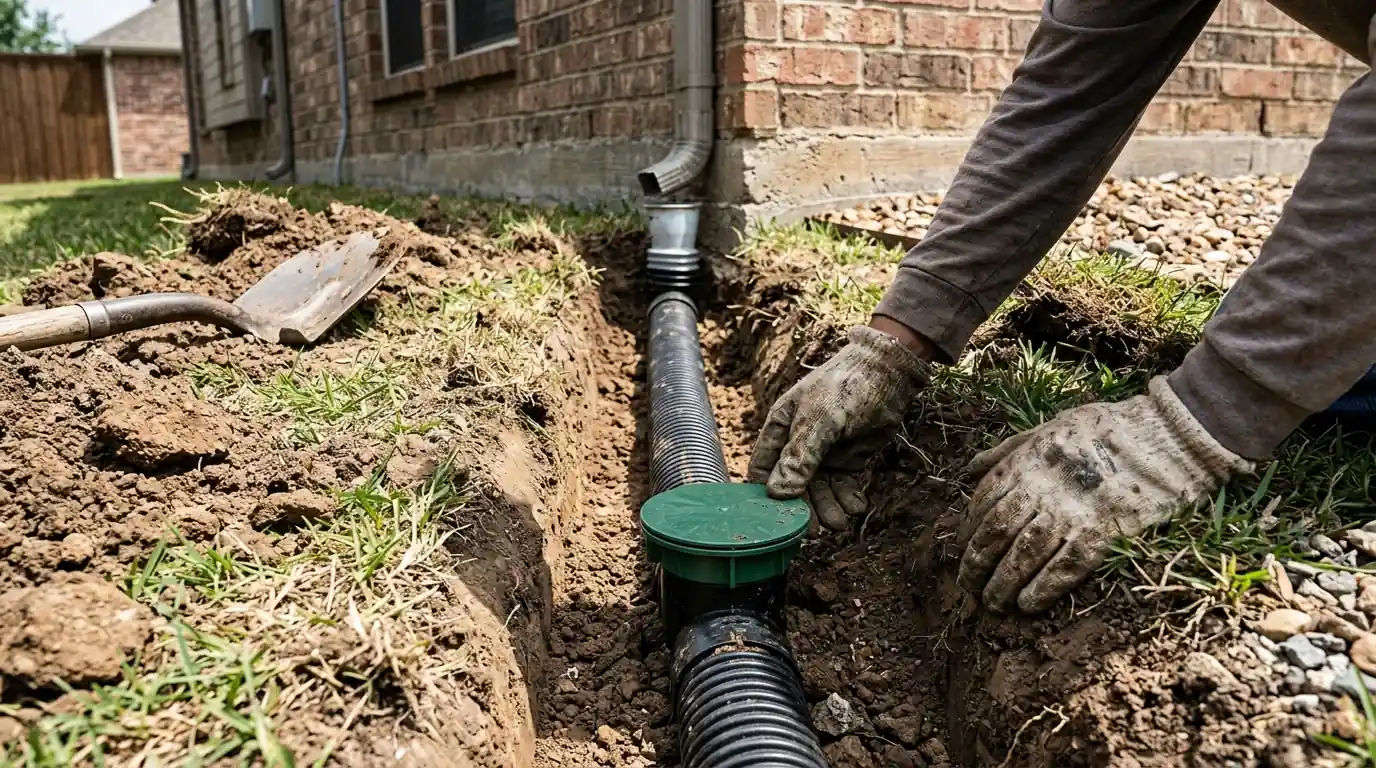
A pop-up emitter sits flush with the lawn at the end of the line. When water arrives, the lid lifts and lets it out; when the rain stops, it drops closed. It suits yards that slope away from the house. We set it far enough out that the water does not run back toward the slab, and we keep the line pitched so water does not sit in it between storms.
Curb outlets
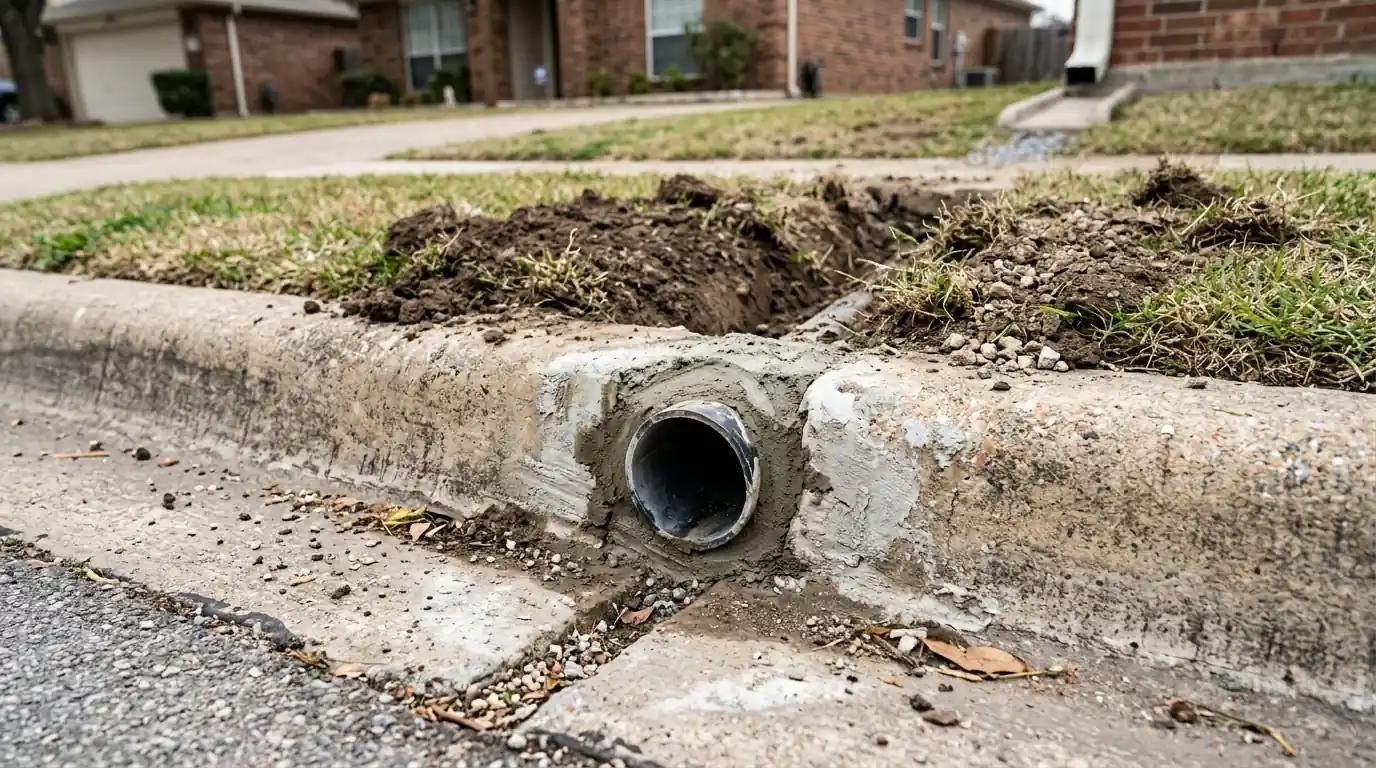
On many Dallas lots the best place for roof water is the street. A curb outlet runs the line under the parkway and out through the face of the curb into the gutter. Cities set rules for cutting curbs and parkways, so we check what the city allows at your address before planning one, and we will tell you if a curb outlet is not an option.
Daylight outlets
Where the back of the lot drops away, the line can simply open onto the lower ground, called daylighting. It is the simplest outlet and the hardest to clog, as long as the outlet is protected from mowers and kept clear of debris. We add a grate or rock apron so the water does not cut a gully.
Cleanouts
A cleanout is a capped riser near the downspout where a hose or drain snake can reach the line. Without one, clearing a clog means cutting into the pipe. We put one on every line we bury, and we show you where it is.
Brands and product lines we install
Brands and product lines we install: Englert, Senox, Berger, OmniMax, Klauer, Mueller, Spectra, Gutterglove, MasterShield, Raptor, Flex-A-Spout, NDS, ADS, Zurn.
We use drainage parts from makers like NDS and ADS, picked for the outlet and soil at your house.
Why roof water matters on Dallas clay
Most of Dallas sits on clay, much of it Houston Black clay, which swells when soaked and shrinks and cracks in dry spells. A downspout that dumps beside the slab keeps that one corner wetter than the rest of the house, and uneven moisture is what moves a foundation. Burying the line evens that out by sending the water somewhere it can drain away from the building.
Signs your downspouts need a buried line
- Puddles at the wall
Water stands beside the foundation after every rain.
- Washed-out beds
Mulch and soil carved away below a downspout.
- Wet patio or walk
Downspout water runs across a walkway or patio.
- Cracks near a corner
New cracks in brick or drywall near a downspout corner.
- Nowhere for an extension
Beds, a driveway or a fence leave no room for one.
How we install an underground drain
Plan the route
We find where the water can leave and mark the path.
Locate utilities
Lines are marked before we dig.
Dig and slope
A trench pitched downhill the whole way.
Lay and connect
Pipe, cleanout and outlet go in and are joined.
Backfill and test
Soil goes back and a hose proves the flow.
Underground drain questions
Far enough that it cannot run back to the house. On most Dallas lots that means past the beds and onto ground that slopes away.
They can, which is why we add a cleanout and keep the line sloped so water does not sit in it.
Often, through a curb outlet, but cities set rules for that, so we check what is allowed at your address first.
A dry well can hold the water underground and let it soak in slowly away from the house.
We dig a narrow trench and put the soil or sod back, so the yard recovers quickly.
Yes, often. We size the main line for the combined roof area.