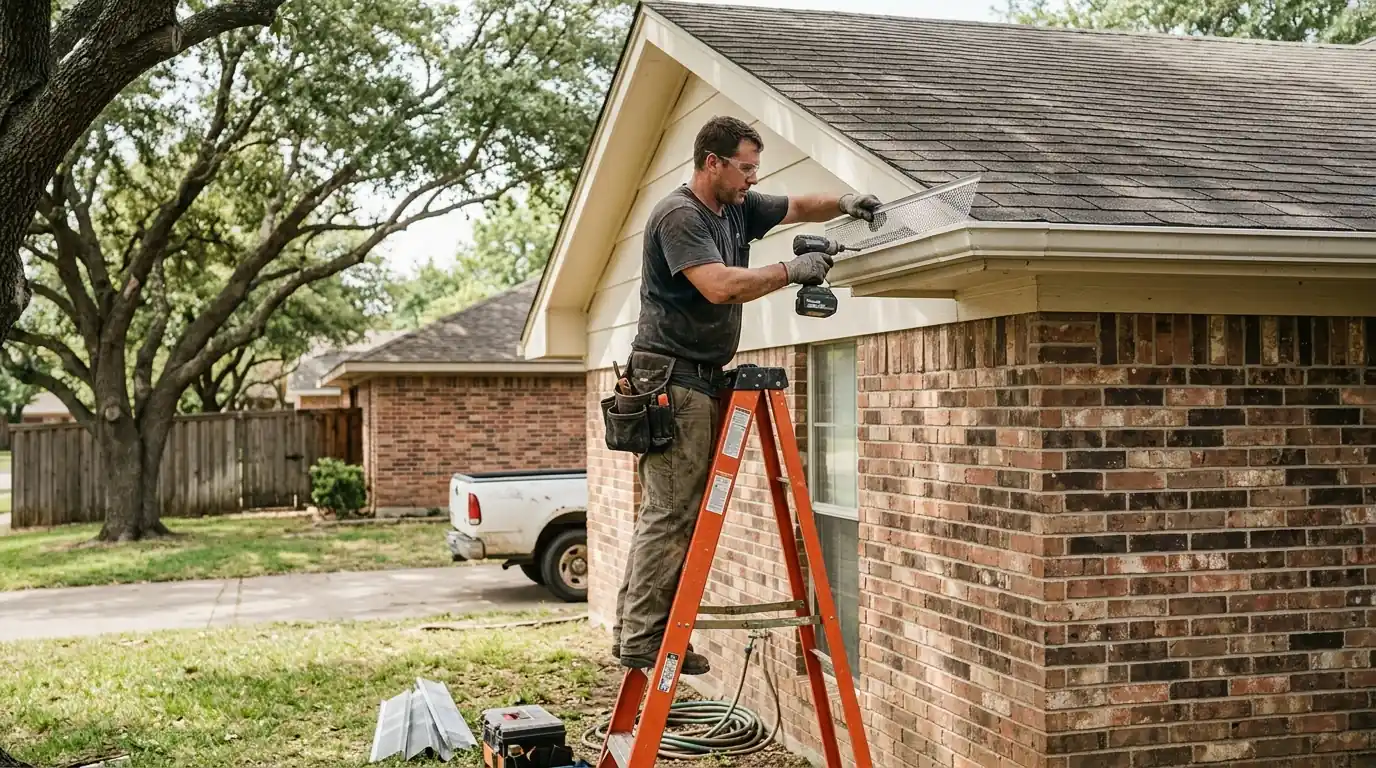
Short answer. Gutter guards in Dallas typically run about $5.75 to $12.25 per linear foot installed, and micro-mesh is the type that handles small oak catkins and pecan debris best. No guard ends maintenance. Mesh still collects a film on top, so we tell you how often yours will need a wipe before you buy.
What a guard does and does not do
A guard keeps the bulk of the debris out of the trough so the gutter keeps draining between cleanings. That matters most under big trees, where an unguarded gutter can fill in one season.
What it cannot do is make the roof stop shedding. Leaves sit on top of a screen; fine dust and pollen form a mat on mesh. We fit guards to sound gutters only, so if your runs sag or leak we will say so and fix that first, and we set the guard angle so the roof edge and drip edge still feed water into the trough.
Which guard suits which Dallas yard?
| Micro-mesh | Screen | Reverse-curve | Foam or brush | |
|---|---|---|---|---|
| Oak catkins and pecan tassels | Stops them | Some get through | Mostly slide off | Get trapped inside |
| Large leaves | Sit on top | Sit on top | Slide off the front | Pack into the insert |
| Heavy storm flow | Good | Good | Can overshoot | Slows flow |
| Upkeep | Wipe the surface | Clean the trough sometimes | Clean the front lip | Replace every few years |
What moves the price of gutter guards
Guards are priced by the foot, and the type is the biggest factor.
- 1Guard type
Micro-mesh costs the most; screens and inserts the least.
- 2Gutter size
Six-inch gutters need wider guards than five-inch.
- 3Linear footage and corners
More runs and corners mean more cutting and fitting.
- 4Gutter condition
Sagging or leaking runs get fixed before a guard goes on.
- 5Roof height and pitch
Steep and two-story roofs take longer to fit safely.
National cost guides put professionally installed guards at about $5.75 to $12.25 per linear foot (LawnStarter), and aluminum micro-mesh at about $6 to $13 per foot installed (US Waterproofing, citing Angi and HomeAdvisor). These are planning ranges, not our quote.
Micro-mesh guards
Micro-mesh is a fine stainless or aluminum screen on a rigid frame. It stops oak catkins, pecan tassels and shingle grit that go straight through larger screens. It costs more, and its weak spot is a film of pollen and fine debris that builds on top, which a soft brush or hose clears. It is the guard we suggest most often under Dallas oaks and pecans.
Screens
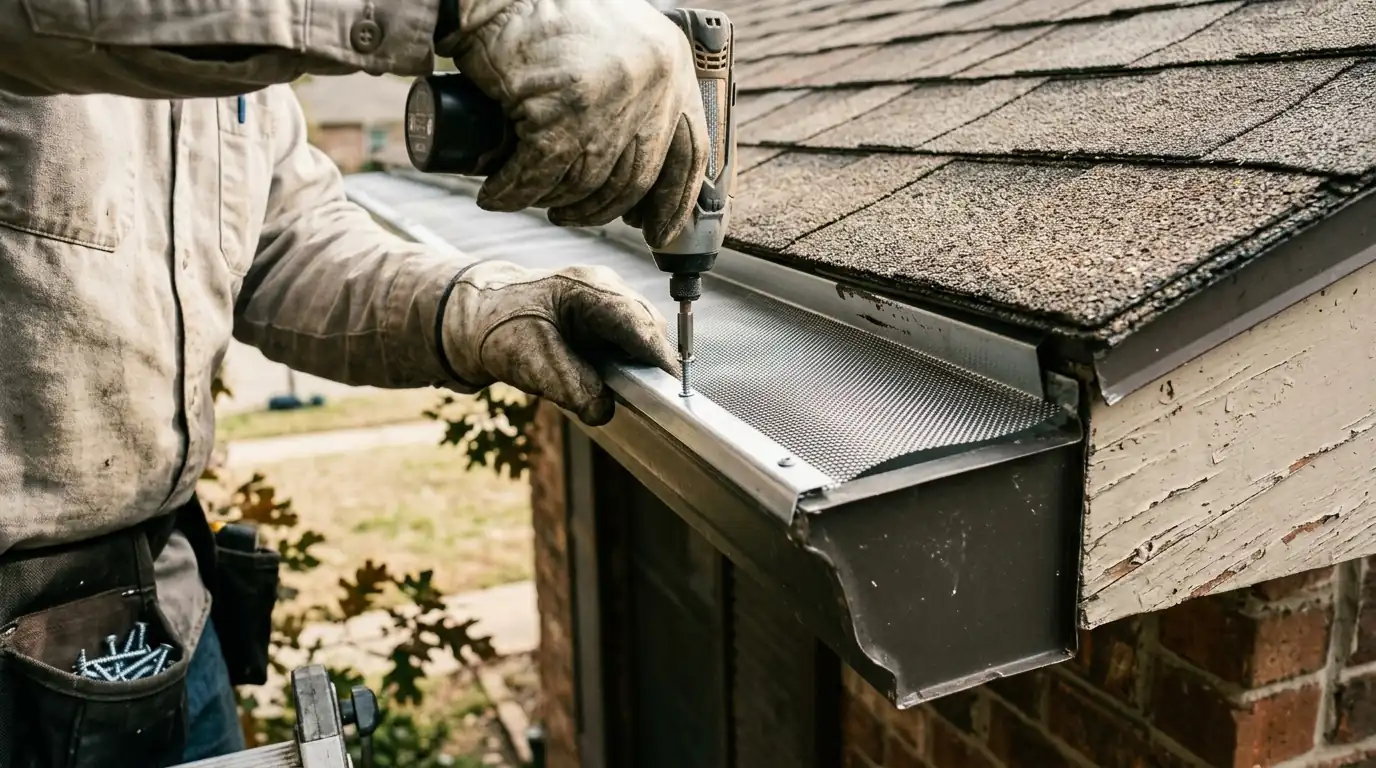
Perforated aluminum or expanded-metal screens keep out whole leaves and twigs and cost less than micro-mesh. Small debris gets through the holes, so the trough still needs an occasional cleaning. They are a sensible choice under trees with large leaves and little fine litter, or on a rental where budget matters most.
Reverse-curve covers
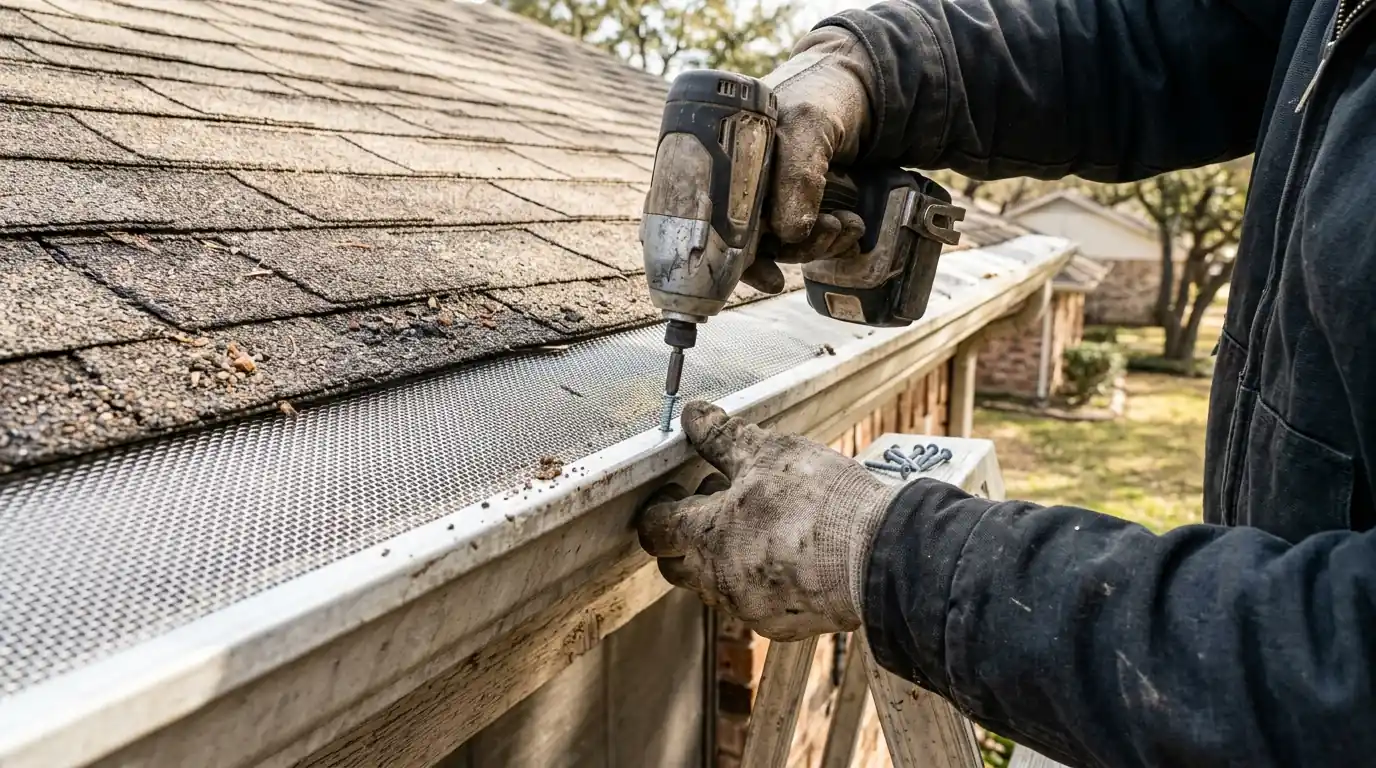
Reverse-curve covers use surface tension: water follows the curved nose into the gutter while leaves slide off the front. They work on moderate roofs but can overshoot in the heaviest storms, and debris that slides off lands in the beds below. We are honest that they suit some Dallas roofs and not others.
Foam and brush inserts
Foam blocks and bristle brushes sit inside the gutter. They are cheap and easy, and they are also where we most often find seedlings growing and debris packed in. We fit them only when you ask, and we often remove failed inserts for homeowners who tried them.
Brands and product lines we install
Brands and product lines we install: Englert, Senox, Berger, OmniMax, Klauer, Mueller, Spectra, Gutterglove, MasterShield, Raptor, Flex-A-Spout, NDS, ADS, Zurn.
Product lines we fit include Gutterglove, MasterShield and Raptor, chosen for your trees rather than for a sales sheet.
What a guard installation includes
- A look at the trees and roof that feed each run
- A full cleaning of the gutters first
- Fixing loose hangers and leaking joints before guards go on
- Guards cut and fitted at corners and outlets
- Fastening suited to your roof edge and fascia
- A hose test with the guards in place
- A plain note on how often yours will need a surface clean
Guards under Dallas oaks and pecans
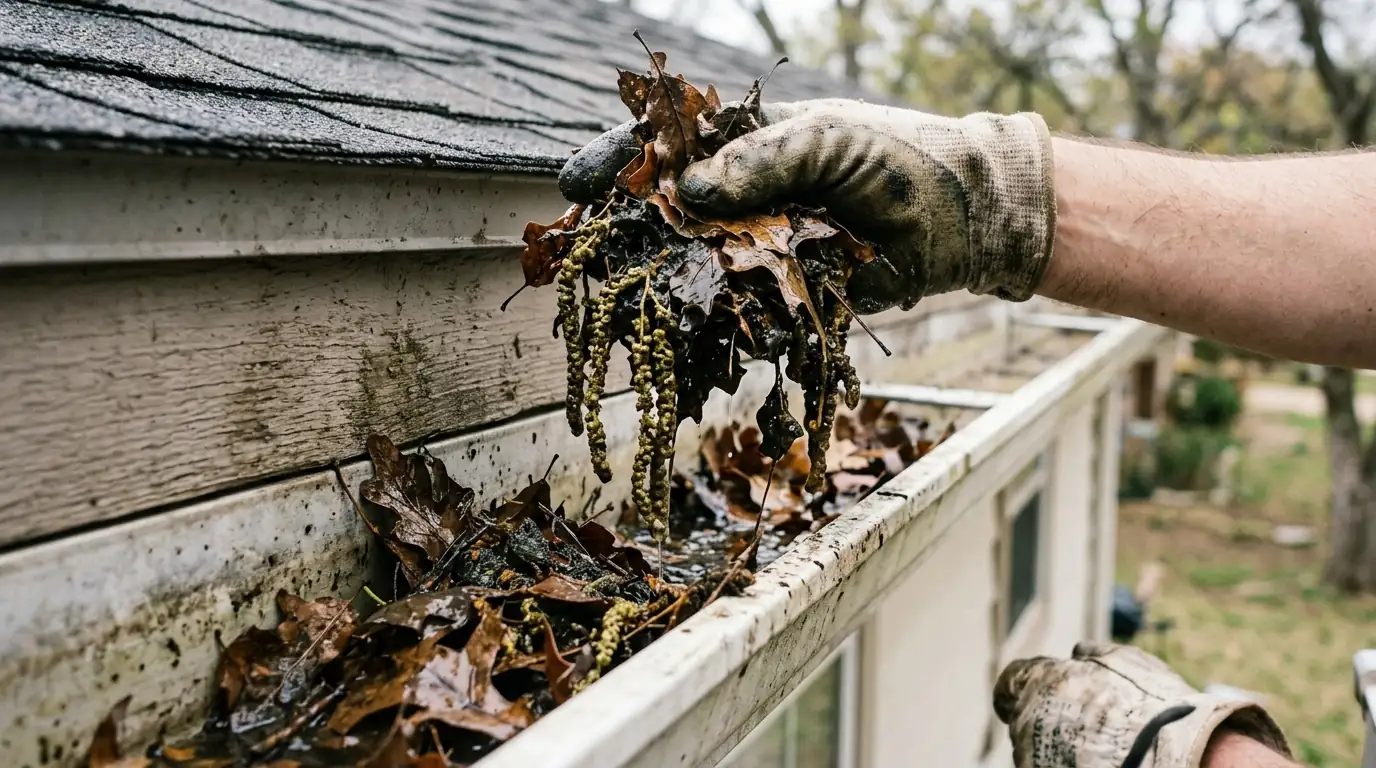
Guard choice matters most in the older tree-lined parts of Dallas. In the M Streets and Vickery Place, conservation districts keep Tudors and Craftsman cottages under century-old oak and pecan trees, and those trees drop catkins and tassels that pour through coarse screens. Preston Hollow is known for big trees too. On lots like these, micro-mesh is usually worth the extra cost; on younger suburban streets with small trees, a screen often does the job.
How we fit gutter guards
Look at the trees
We note what drops on your roof and when, then suggest a guard type.
Clean and repair
Gutters are emptied and any sag or leak is fixed first.
Measure and cut
Guards are cut to each run, with care at corners and outlets.
Fasten
Guards go on to suit your roof edge and fascia.
Test with water
We run a hose on the roof to check water still gets in.
Gutter guard questions
No. They cut how often the trough needs cleaning, but the surface still collects debris, especially pollen and catkins on mesh.
Micro-mesh, because its fine holes stop catkins and tassels that go through larger screens.
Usually yes, if the gutters are sound. We fix sags and leaks first.
Good micro-mesh and screens handle most storms. Reverse-curve covers can overshoot in the heaviest downpours.
National guides put installed guards at about $5.75 to $12.25 per foot. We price yours after measuring.
Yes, with the right ladders and setup for the height.