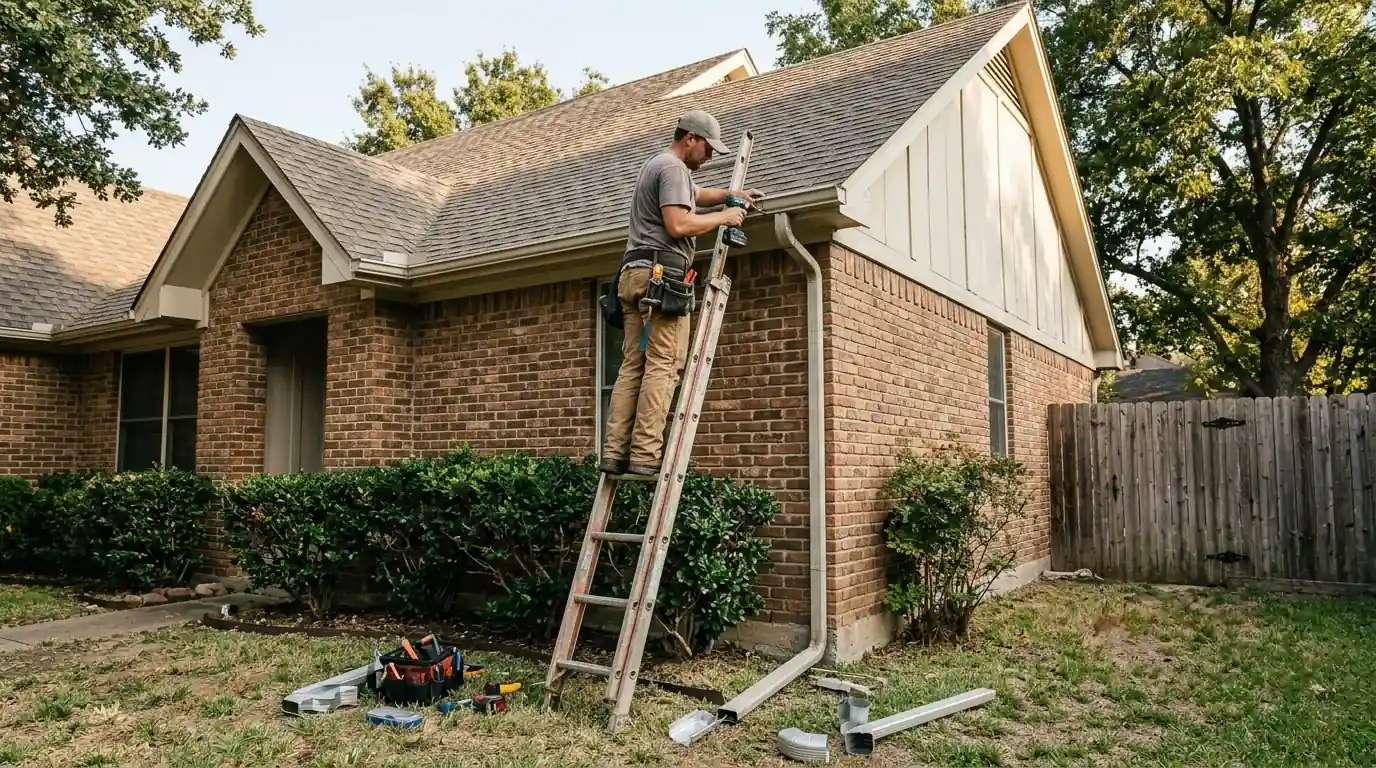
Short answer. Downspout extensions in Dallas carry roof water from the bottom elbow out into the yard, ideally 4 to 6 feet from the foundation, so it does not soak the clay beside the slab. Extensions typically cost about $9 to $38 each by national estimates. Where beds or walks are in the way, a buried line is the better fix.
Why extensions matter
A downspout that ends at the wall dumps every gallon from that part of the roof in one spot. Over a storm, that is a lot of water in one corner, and on clay soil it is the one corner of the house that stays wettest.
An extension moves the discharge out to where the ground can take it. It is simple, cheap and quick, and on most houses it is the first fix we suggest. Where there is no room for one, an underground line does the same job under the beds and walks.
Splash blocks
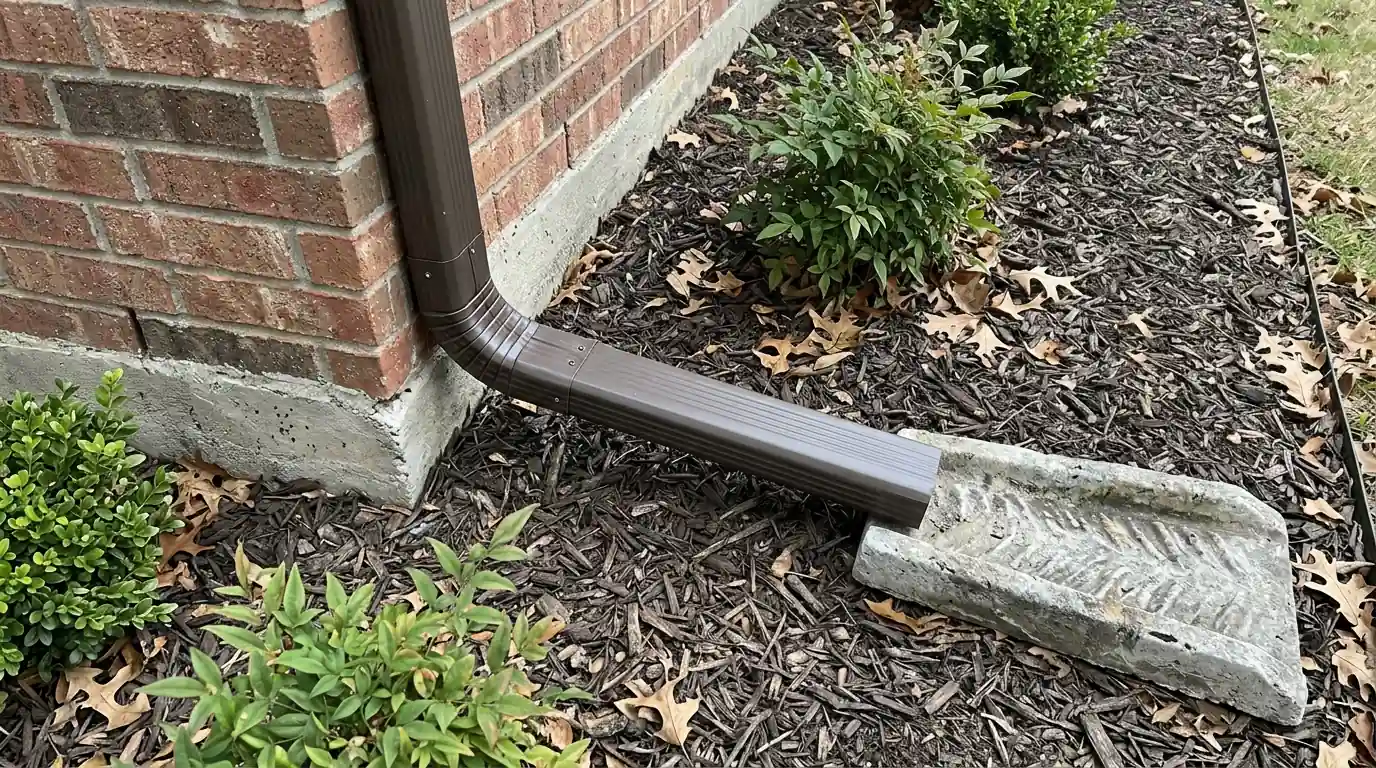
A splash block is a sloped concrete or plastic pad under the elbow. It spreads the water and stops it digging a hole, but it only moves water a couple of feet. We use them where the ground already slopes away, and pair them with an extension where it does not.
Hinged flip-up extensions
Hinged extensions attach to the elbow and flip up out of the way when you mow, then drop back down. They suit downspouts that sit beside the lawn. We fit them with a secure hinge and make sure they actually fall back into place, since an extension left up does nothing.
Roll-out extensions
Roll-out sleeves unroll when water flows and roll back up when it stops. They are tidy, but they wear out in Texas sun and do not carry water as far as a solid extension. We use them where looks matter and the water does not need to travel far.
Discharge direction
Where the extension points matters as much as how long it is. Water aimed at a neighbor's yard, a driveway that slopes back to the garage, or a walkway that ices in a winter storm causes new problems. We point each one where the yard slopes away and the water can soak in or run off safely.
Why discharge distance matters in Dallas
Dallas soils are largely clay, much of it Houston Black clay, which makes foundations prone to shifting when moisture is uneven. A downspout that empties against the wall keeps one corner of the slab wetter than the rest, and that difference is what clay turns into movement. Carrying the water a few feet out evens it out, which is why we treat extensions as part of every gutter job.
How we fit extensions
Walk the house
We check where each downspout lets out and how the ground slopes.
Pick the type
Splash block, hinged or roll-out for each spot.
Fix the elbow
Crushed or loose elbows replaced first.
Fit and fasten
Extensions attached so they stay put.
Test with a hose
We watch where the water goes.
Signs your downspouts need extensions
- Washout at the base
A hole or bare patch right under the downspout.
- Wet soil at the wall
Soil against the foundation stays damp after rain.
- Mulch carried away
Beds washed out below the elbow.
- Water at the slab edge
Puddles touching the foundation after storms.
- Cracks near the corner
New cracks in brick or interior walls near that downspout.
What changes the cost of extensions
Extensions are one of the cheapest drainage fixes we install.
- 1Type
Splash blocks and roll-outs cost less than rigid hinged extensions.
- 2Number of downspouts
Most homes need several.
- 3Elbow condition
Crushed elbows are replaced first.
- 4Length needed
Longer runs need longer extensions or a buried line.
- 5Obstacles
Beds, walks and drives may push the job underground.
A national cost guide puts a downspout extension at about $9 to $38 each (HomeGnome). This is a planning range, not our quote.
Fitting an extension yourself
Simple to do yourself
- Slip an extension onto a ground-level elbow
- Set a splash block under the outlet
- Re-point an extension after mowing
Call us when
- Beds, walks or a drive block every direction
- The ground slopes back toward the house
- You want the water carried underground
Downspout extension questions
Common guidance is 4 to 6 feet from the foundation, onto ground that slopes away.
Only where the ground already slopes away. Otherwise an extension carries water farther.
Hinged extensions flip up for mowing and drop back down.
We run the downspout into a buried line that lets out farther away.
They wear out faster in Texas sun than rigid extensions.
Yes, and it is often the best moment to do it.