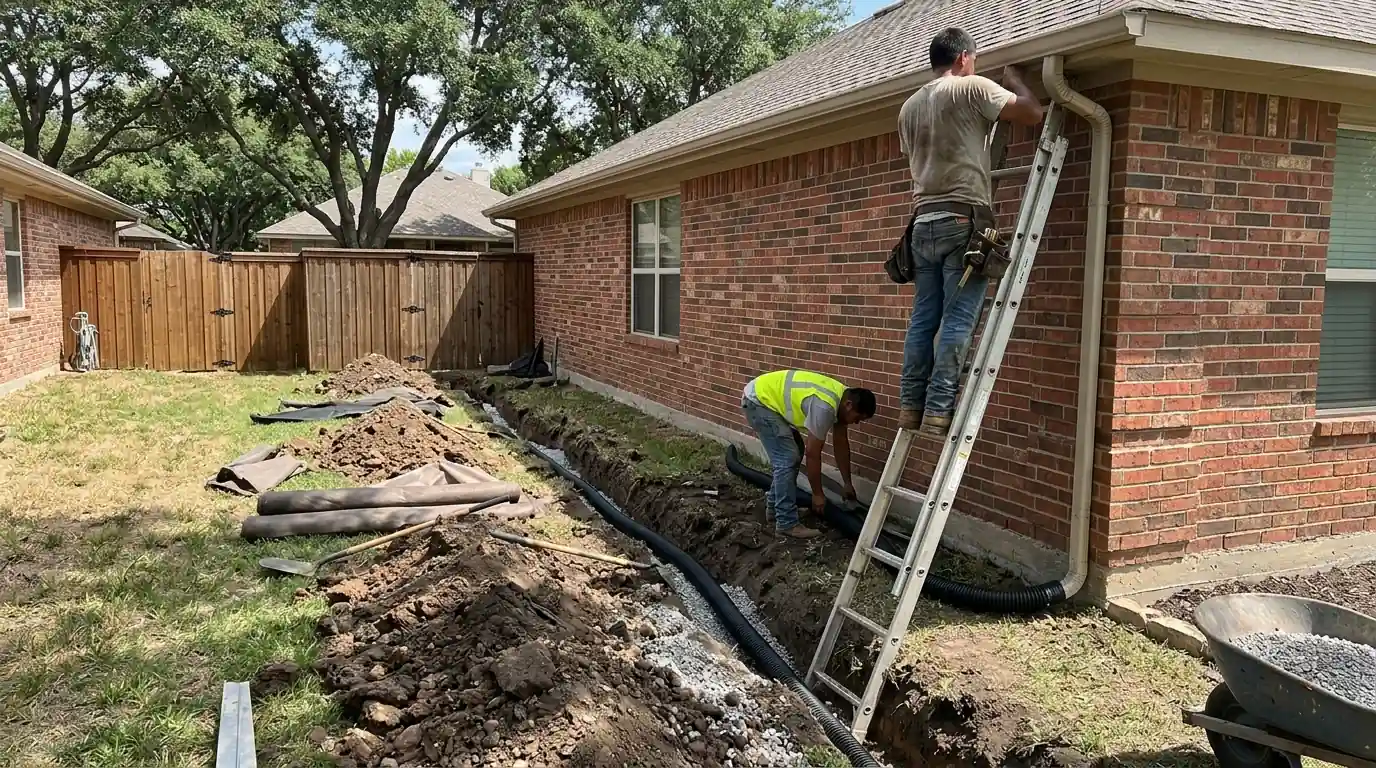
Short answer. A French drain in Dallas is a gravel-filled trench with perforated pipe that collects ground water from a wet area and carries it to a lower outlet. Exterior French drains typically cost about $10 to $65 per linear foot by national estimates, and most projects land around $2,800 to $6,500. The outlet decides whether it works.
When a French drain is the right fix
A French drain handles water already in the soil: a lawn that squishes days after rain, a strip along a fence that never dries, ground water running toward the slab from an uphill neighbor. It collects water along its whole length, which surface drains cannot do.
It is the wrong fix for roof water. Pouring downspouts into a French drain overloads it and fills it with roof grit. Roof water belongs in solid pipe, an underground downspout line, which can run beside the French drain to the same outlet.
What changes the price of a French drain
French drains are priced by the foot, with the outlet and the soil as the big variables.
- 1Length of the trench
Most of the cost is digging and gravel per foot.
- 2Depth
Deeper drains move more soil and need more gravel.
- 3Soil and roots
Dense clay and tree roots slow the dig.
- 4The outlet
Daylight is simplest; a dry well or curb outlet adds cost.
- 5Restoring the yard
Sod, beds or concrete crossed along the way.
National cost guides put exterior French drains at about $10 to $65 per linear foot (LawnStarter), with most professional projects around $2,800 to $6,500 (Lawn Love). Dry wells add about $500 to $3,000. These are planning ranges, not our quote.
Yard French drains
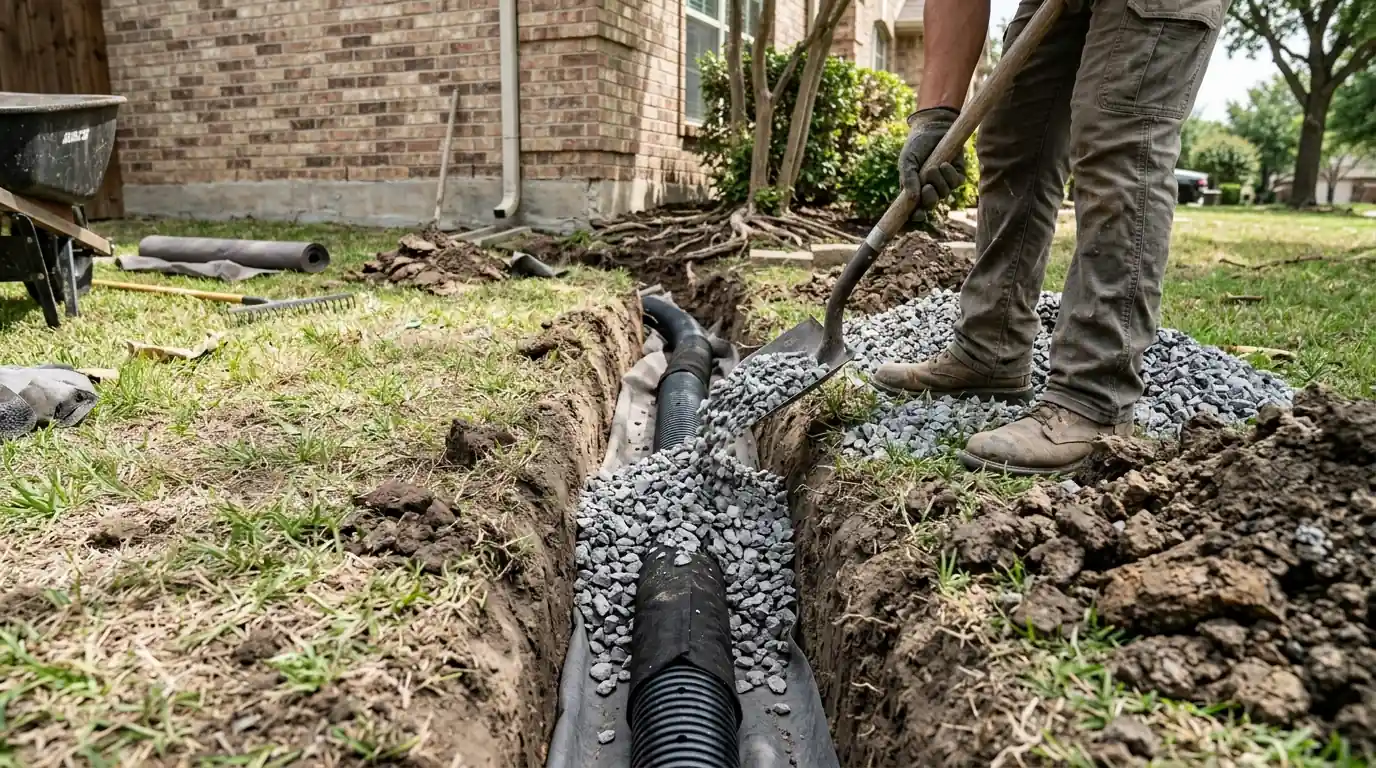
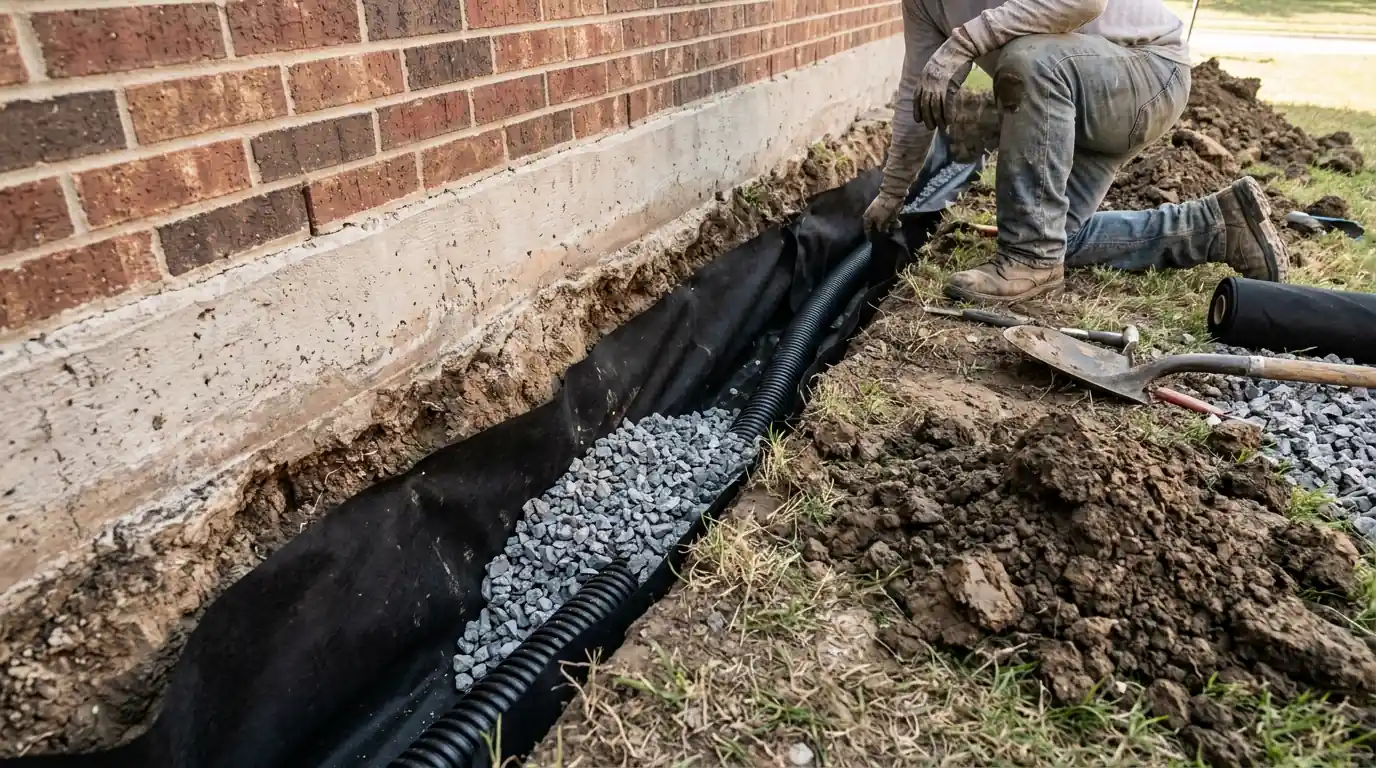
Across or around a soggy area, we dig a trench, line it with filter fabric, lay perforated pipe in clean gravel and wrap the fabric over the top before the soil and sod go back. The fabric keeps clay fines from clogging the gravel. The trench is sloped the whole way so collected water keeps moving to the outlet rather than sitting in the pipe.
Along the foundation
When ground water moves toward the slab from higher ground, a drain between the house and the slope intercepts it. We keep it a sensible distance from the foundation, not right against it, and we are careful about how deep we dig next to a slab on clay. On some homes the right answer is regrading plus a drain, not a drain alone.
Dry wells
Flat lots often have no lower ground to drain to. A dry well is a buried chamber or gravel pit at the end of the line that holds the water and lets it soak away slowly, well clear of the house. In dense clay it drains slowly, so we size it generously and keep it far from the slab.
Outlet and daylight
The outlet is where most French drains fail. Ideally the line daylights onto lower ground, protected by a rock apron so it does not cut a gully. Where it cannot, we use a pop-up emitter, a curb outlet where the city allows one, or a dry well. We do not build a drain with nowhere to go.
Brands and product lines we install
Brands and product lines we install: Englert, Senox, Berger, OmniMax, Klauer, Mueller, Spectra, Gutterglove, MasterShield, Raptor, Flex-A-Spout, NDS, ADS, Zurn.
Pipe, fabric and fittings come from makers like ADS and NDS, chosen for the soil and the length of the run.
French drains on sloped Dallas lots
French drains earn their keep on the hilly side of Dallas. Kessler Park, south of the Trinity River, is known for its hills and trees, and on lots like those ground water from uphill yards moves downhill toward the houses below. Add the expansive clay under most of the city, which swells as it soaks up that water, and an intercepting drain across the slope is often the most useful thing a yard can have.
Digging one yourself, and the usual mistakes
A homeowner can manage
- Short, shallow drains in open lawn
- Clearing an existing outlet of debris
- Watching where water stands so the route is right
Worth calling us
- Drains near the foundation
- Lots with no obvious outlet
- Long runs through dense clay or roots
How long a French drain takes
A straightforward 50 to 75 foot yard drain is usually a one to two day job, including putting the sod back. Longer runs, dense clay, tree roots, or a dry well at the end add time. We give you the plan and the time before we start digging, and we leave the yard level, not mounded.
How we install a French drain
Find the water
We walk the yard after rain if we can and shoot grades.
Plan the outlet
Daylight, pop-up, curb or dry well, decided first.
Dig and line
Sloped trench lined with filter fabric.
Pipe and gravel
Perforated pipe set in clean gravel, fabric wrapped over.
Close and test
Soil and sod back, then water run through it.
French drain questions
Most yard drains run about 18 to 24 inches deep, deeper where they intercept water moving toward a foundation.
Better not. Roof water overloads it and fills it with grit. We run downspouts in solid pipe beside it.
Yes, if they have an outlet. Clay drains slowly, so the pipe and the outlet do the real work.
Built with fabric and clean gravel, decades. Clogged fabric or a blocked outlet shortens that.
We put the soil and sod back, and the trench line usually disappears within a season.
A dry well at the end of the line can hold the water and let it soak away slowly.