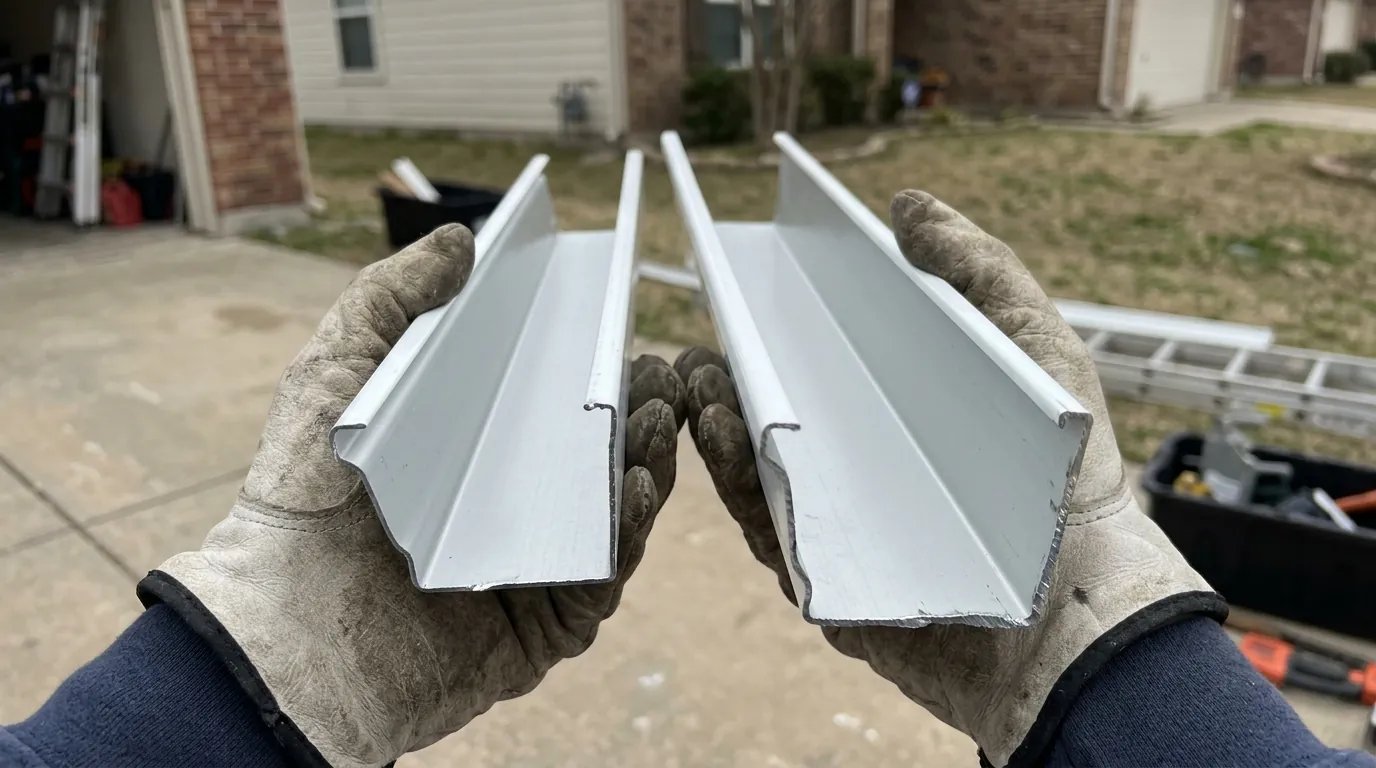
Short answer. A 5-inch K-style gutter is enough for most single-story Dallas homes with moderate roof pitch. Steep roofs, large two-story planes and runs fed by a valley usually need 6-inch gutters with 3x4 downspouts. If your gutters spill over in heavy rain while they are clean, the system is undersized.
What the size actually measures
The number is the width across the top of the trough. A 6-inch K-style gutter is wider and deeper than a 5-inch, so it holds more water at once and is harder for a fast stream to jump over. It also takes a wider outlet, which is where much of the real gain comes from.
Size is about flow, not looks. Two houses with the same footprint can need different gutters because one has a steep roof that sheds water fast and the other has a gentle pitch that lets it drain off slowly.
Roofs that usually need 6-inch
We look at how much roof drains into each run and how fast it arrives. These are the situations where 5-inch troughs tend to overflow:
- Steep roofs, where water reaches the gutter fast and overshoots a narrow trough.
- Two-story homes with large upper roof planes draining to one eave.
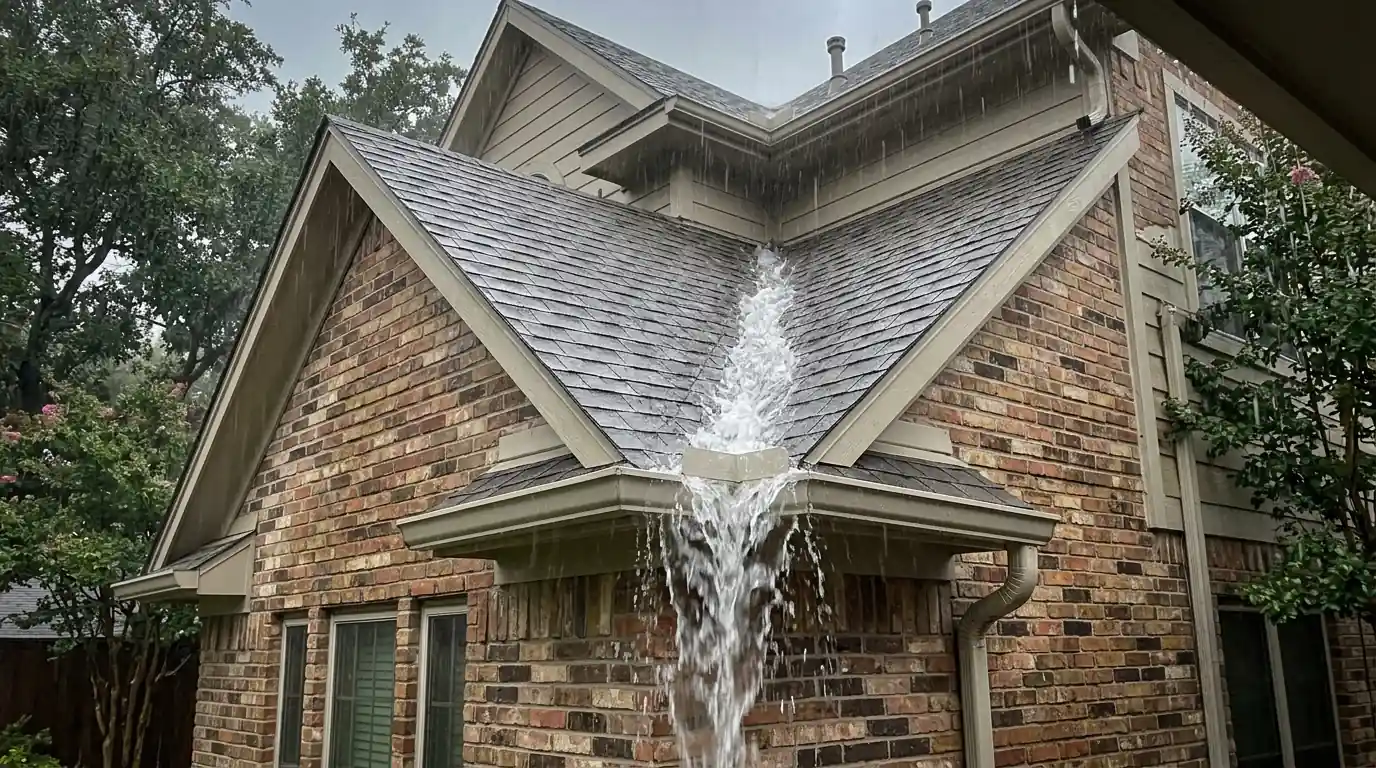
- Inside corners below a valley, where two planes pour into one spot.
- Metal roofs, which shed water faster than shingles.
- Long runs with a single outlet at one end.
The downspout matters as much as the trough
A bigger gutter feeding a small downspout still backs up. Most builder systems use 2x3 downspouts; 6-inch gutters are normally paired with 3x4, which drains much faster. Sometimes adding an outlet or upsizing the downspout fixes overflow without replacing the gutter at all.
| 5-inch with 2x3 | 5-inch with 3x4 | 6-inch with 3x4 | |
|---|---|---|---|
| Typical use | Builder standard | Busy 5-inch runs | Steep, large or valley-fed roofs |
| Overflow in hard rain | Most likely | Less likely | Least likely |
| Cost | Lowest | Low | Higher |
Dallas rain makes the case
Dallas averages about 37 inches of rain a year under the 1991-2020 normals, and May is the wettest month at about 4.8 inches. Averages hide the bursts that actually test gutters: DFW recorded 16.96 inches of rain in May 2015 alone. Gutters have to be sized for those storms, not the average day.
When 5-inch is the better choice
Upsizing is not always right. On a small single-story house with a moderate roof, 5-inch gutters with properly placed downspouts drain fine, cost less, and look in proportion. On a house with a lot of decorative trim, a 6-inch profile can look heavy.
- Single-story homes with moderate pitch and no big valleys.
- Runs that only overflow because they are clogged or pitched wrong.
- Homes where an extra 3x4 outlet solves the overflow.
You can upsize only the runs that spill
Gutter size does not have to be all or nothing. We often keep 5-inch on the runs that work and put 6-inch only where valleys or steep planes overwhelm the trough. Matching colors keeps the change from showing. The time to do it is when gutters are being replaced anyway, since upsizing a run means a new run.
What a 6-inch upgrade involves
Upsizing is a replacement job. The old runs come down, the fascia behind them is probed and any soft boards replaced, and new 6-inch runs are formed to length on site. Hangers go back at close spacing, because a full 6-inch trough weighs more than a 5-inch one. Outlets are cut for 3x4 downspouts, and each downspout gets an extension or a buried line so the extra water the bigger gutter collects does not end up at the slab. If guards are going on, they have to be the 6-inch width too.
Services that solve undersized gutters
Gutter size questions
If they spill over the front in heavy rain while they are clean, they are undersized for that part of the roof.
Yes. They pair with 3x4 downspouts; a 2x3 outlet will still back up.
Yes. Upsizing only the runs that overflow is common and saves money.
No. The wider trough and larger outlet actually clog less easily.
Sources for this guide
- Dallas climate normals, Climate-Zone
- DFW rainfall records, iWeatherNet
- Seamless gutter costs, RoofingCalc
Figures are national or regional planning numbers from the sources above, not a quote for your home.