Short answer. On Dallas's 1920s and 1930s homes, the gutter questions are profile, corners and wood. Half-round or copper gutters often suit the architecture better than K-style; steep, intersecting gables mean many corners to seal; and original fascia and rafter tails need checking before anything is hung. In a conservation district, check exterior-change rules first.
Where these houses are
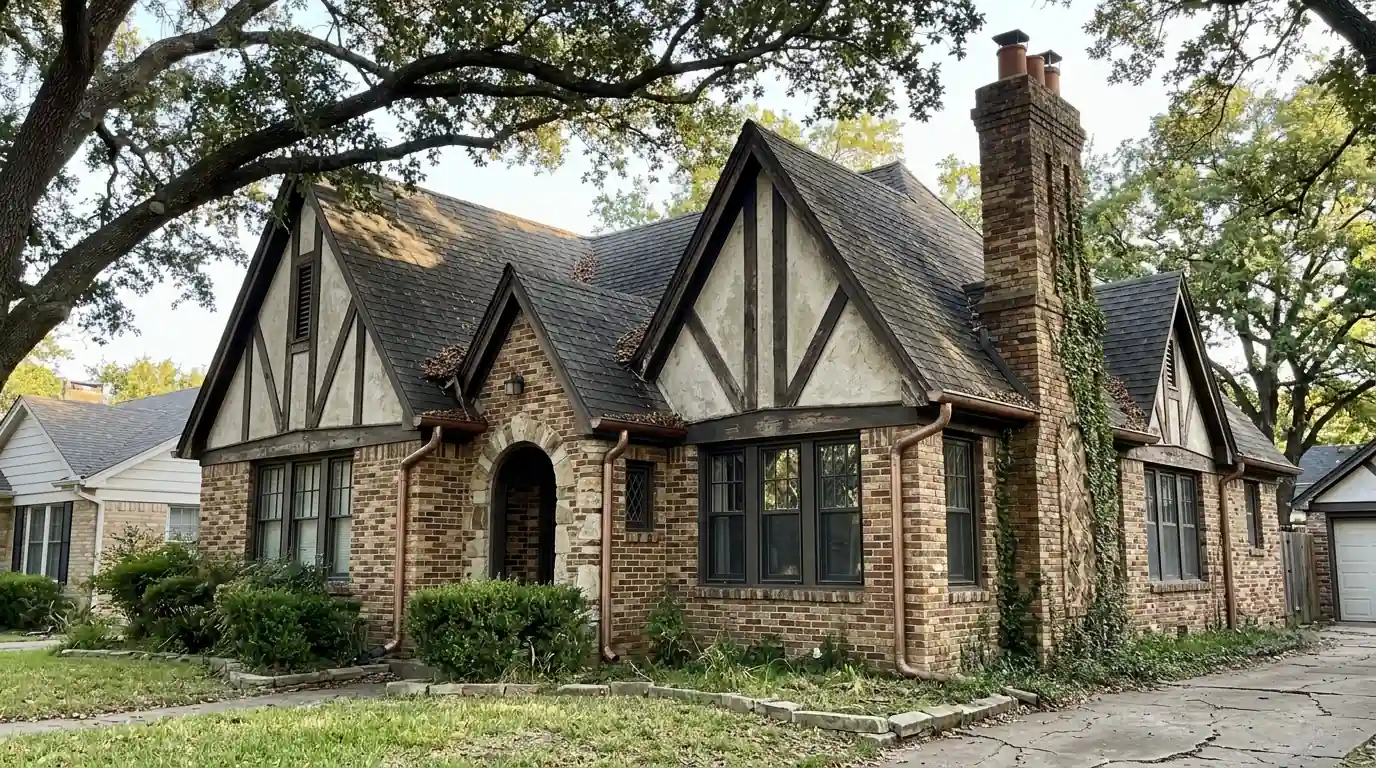
Dallas's older housing stock is concentrated in a few neighborhoods. Greenland Hills, the M Streets, began building in 1923, and over 65 percent of its homes were Tudor Revival when its conservation district formed in 2002. Lakewood was mostly built in the 1920s, when Dines and Kraft built Tudor, Dutch Colonial and Prairie-style homes. Vickery Place was subdivided in the 1910s and 1920s, and Kessler Park is known for homes from the 1930s.
Profile: half-round, copper or K-style
A molded K-style gutter is the default on newer homes, and it can look like an afterthought on a 1920s Tudor. Half-round gutters on brackets, with round downspouts, read as part of the original trim. Copper is the traditional material and ages from bright to brown to green.
Half-round holds a little less water than K-style of the same width, so it has to be sized for the roof. Aluminum half-round in a painted finish gives the look at a fraction of copper's cost.
Many corners, many joints
Tudor rooflines with steep, intersecting gables break the eave into short runs with many inside and outside corners. Each corner is a joint that has to be sealed or soldered, and each is a likely leak point as it ages. Short valleys also pour concentrated streams onto entries and walks, which is where rain diverters and splash guards earn their keep.
Original wood behind the gutter
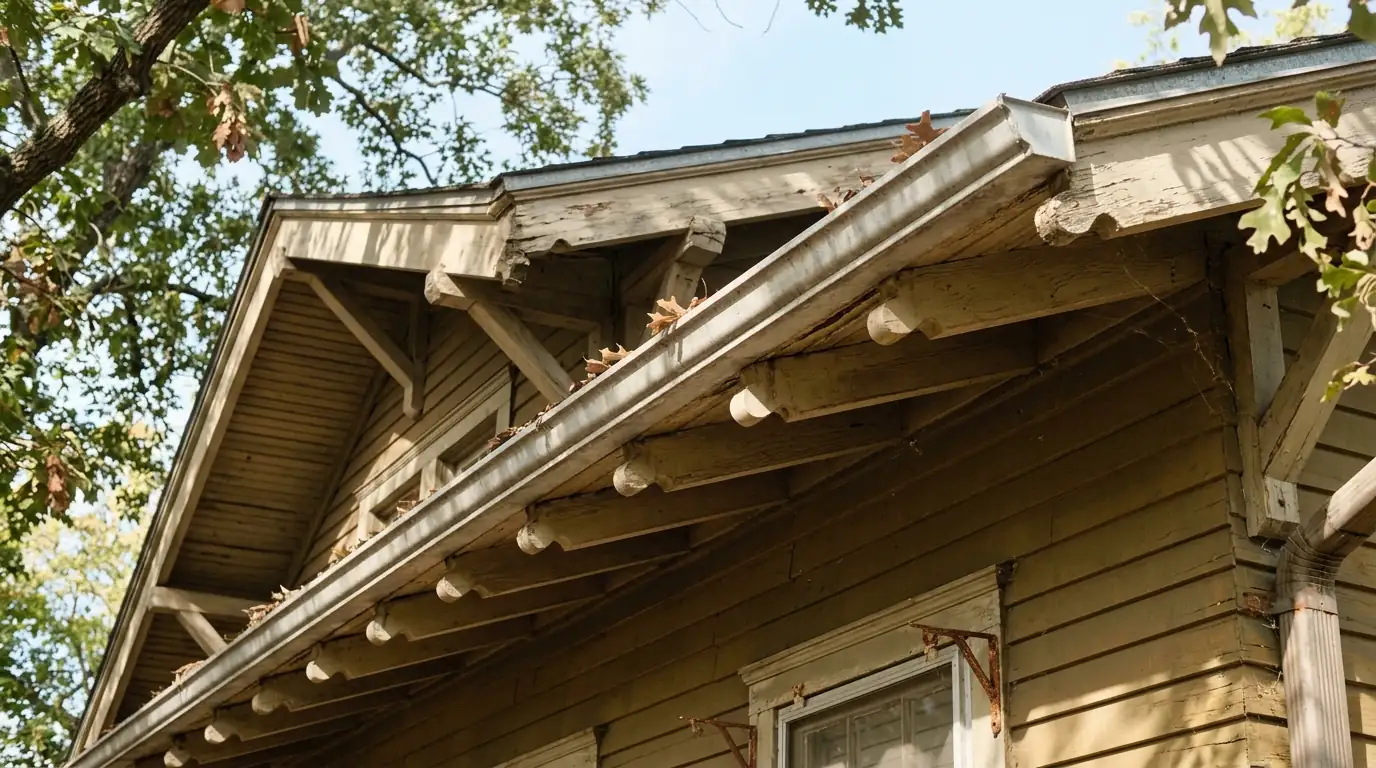
Many older homes still carry original fascia boards and exposed rafter tails, and decades of overflow have often softened the wood behind the gutter. New gutters hung on soft wood pull loose. We probe every board and rafter tail before hanging anything, repair or replace what is soft, and prime new wood on all sides.
Built-in box gutters
Some older homes have gutters framed into the roof edge rather than hung from it. When those linings fail, the leak shows up inside as a stain on a ceiling or wall near the eave. Relining keeps the original look from the street; converting to hung gutters is sometimes cheaper but changes the appearance.
Check the district rules first
The M Streets and Vickery Place are conservation districts, which keep the character of their homes and protect their mature trees. Conservation districts can regulate exterior changes, so check with the city before changing materials or profiles on a house in one. Matching what is there, or going back to a profile that suits the original architecture, is usually the safest choice.
Rules vary by district and change over time. Treat this as a reminder to check, not as a summary of the rules.
What a careful job looks like on an older house
Older houses forgive less. Brick, stucco and stone are drilled only where straps must anchor, using masonry fasteners set in mortar joints rather than the face of the brick. Decorative trim is never nailed through to hang a gutter. Colors are matched to existing trim in daylight, and copper joints are soldered rather than sealed. Downspouts are placed around foundation plantings and walks so water leaves the house without carving through beds that may be decades old. And when a run is replaced, the old profile is noted first, so the new one fits the character of the street.
Services for older homes
Older home gutter questions
Half-round or copper usually look most at home. K-style can work but often looks added later.
Steep, many-gabled rooflines have more corners, and each corner joint ages.
Yes, by resealing joints or relining the trough.
They can regulate exterior changes. Check with the city before changing materials or profiles.
Sources for this guide
- M Streets architectural history, mstreets.org
- Lakewood neighborhood history, D Magazine
- M Streets and Vickery Place guide, Compass
- Kessler Park homes, D Magazine
Figures are national or regional planning numbers from the sources above, not a quote for your home.