Short answer. In Texas, Property Code section 202.007 bars an HOA from prohibiting rain barrels or a rainwater harvesting system, though it can regulate placement and appearance, and Tax Code section 151.355 exempts the equipment from state sales tax. One inch of rain on 1,000 square feet of roof is about 623 gallons, so a single barrel fills fast in a Dallas storm.
What Texas law says
Texas Property Code section 202.007 says a property owners association cannot prohibit or restrict homeowners from installing rain barrels or a rainwater harvesting system. An HOA can still set reasonable rules on where barrels go and how they look, such as color or screening, so read your HOA's guidelines before choosing a spot facing the street.
Texas Tax Code section 151.355 exempts rainwater harvesting equipment and supplies from state sales tax. Ask your supplier how they handle the exemption at checkout.
This is a plain summary, not legal advice. For anything specific to your HOA, read the documents or ask the association.
How much water a Dallas roof gives you
The math is simple. One inch of rain on 1,000 square feet of roof is 144,000 cubic inches of water, about 623 gallons. Dallas averages about 37 inches of rain a year, so in theory that same 1,000 square feet sheds over 23,000 gallons a year, before losses to splash, evaporation and first-flush diversion.
In practice the limit is storage, not supply. A standard barrel holds 50 to 65 gallons, so a single heavy storm can fill several barrels from one downspout.
Sizing your setup
| Setup | Storage | Good for |
|---|---|---|
| One barrel | About 50 to 65 gallons | Pots and a small bed |
| Two or three linked barrels | About 100 to 200 gallons | A vegetable garden |
| Cistern | Hundreds to thousands of gallons | Larger beds and lawns |
Start with the downspout that drains the most roof near where you water. A barrel on a downspout fed by a small porch roof will rarely fill; one below a large plane or a valley fills in minutes.
Setting it up right
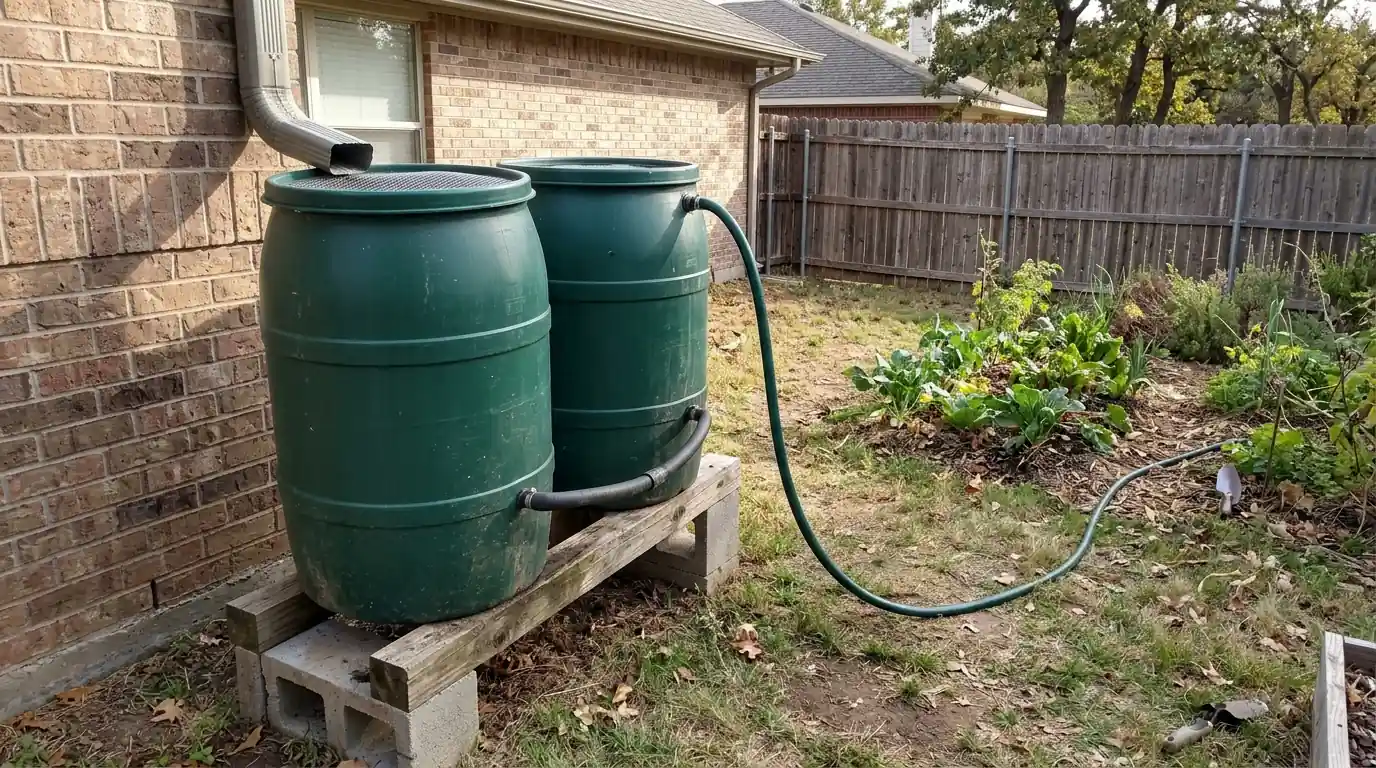
- A level, solid base: a full 55-gallon barrel weighs several hundred pounds.
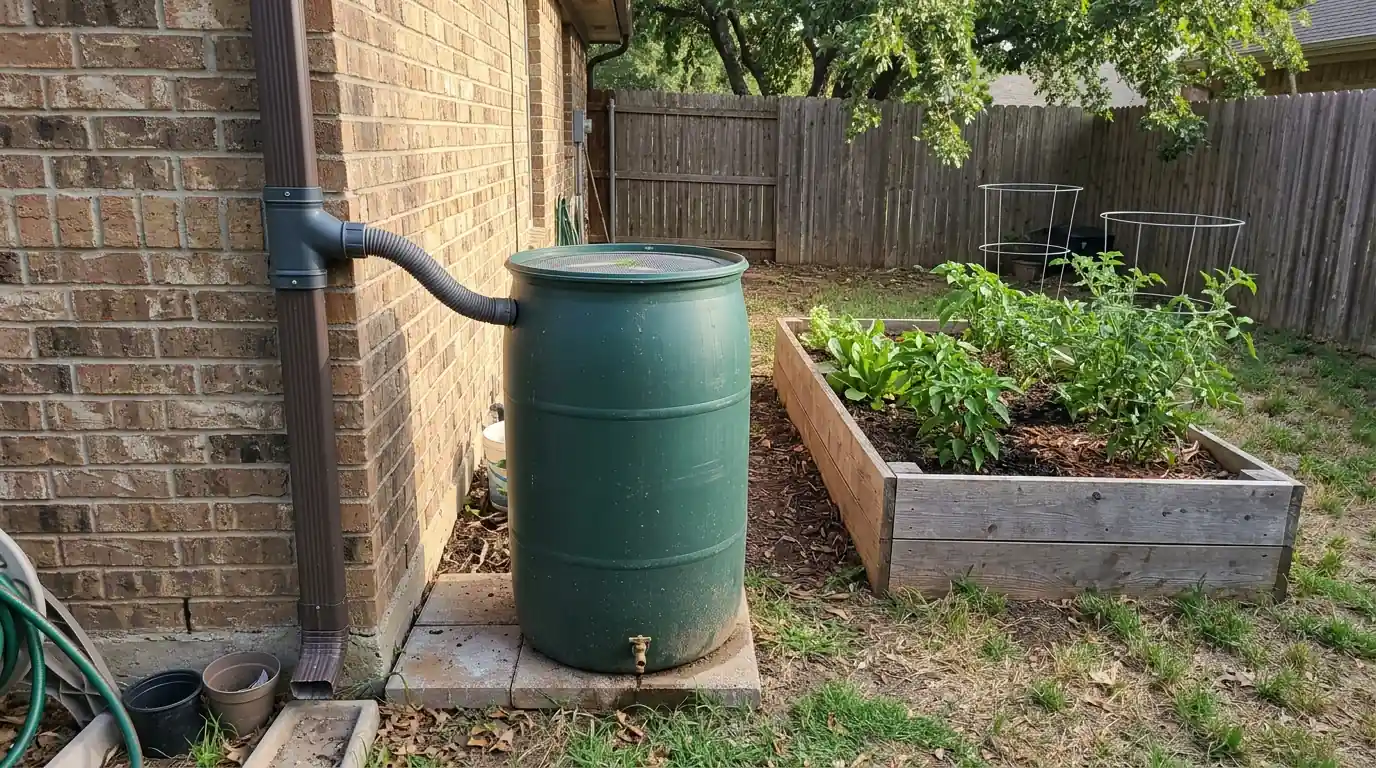
- A diverter in the downspout, so the barrel fills and the rest still drains.
- Fine screens on every opening to keep mosquitoes out.
- A first-flush diverter to send the dirtiest first water away.
- An overflow routed back to the downspout, an extension or a buried line, never against the slab.
Keep the gutters clean
Whatever is in the gutter ends up in the barrel. Clean gutters, a screen at the outlet and a first-flush diverter keep stored water cleaner and keep the barrel from silting up. We install barrels for garden use; drinking water needs treatment beyond a barrel setup.
Common mistakes to avoid
- Setting a barrel on soft soil, where it tips once full.
- No overflow route, so a full barrel spills against the foundation.
- Unscreened openings that let mosquitoes breed.
- Picking a downspout that drains too little roof to fill the barrel.
- Leaving barrels full through a hard freeze, which can split them.
Use the water within a week or two, water in the morning, and keep the lid closed between uses. A barrel that is drawn down regularly stays cleaner and is ready to catch the next storm.
Related services we install
Rain barrel questions
No. Property Code 202.007 bars HOAs from prohibiting them, though they can regulate placement and appearance.
Tax Code 151.355 exempts rainwater harvesting equipment from state sales tax.
In a heavy Dallas storm, a barrel on a busy downspout can fill in minutes.
Not if every opening is screened and the water is used or drained regularly.
Sources for this guide
Figures are national or regional planning numbers from the sources above, not a quote for your home.