Short answer. Seamless gutters are formed to length on site from a coil, so each run has joints only at corners, end caps and outlets. Sectional gutters are joined every 10 or 20 feet, and every joint is a future leak. Installed seamless aluminum runs about $10 to $15.50 per foot by national estimates, which is why seamless is the default for most homes.
How each one is made
Sectional gutters are sold in pre-cut lengths, usually 10 or 20 feet, and joined on the house with slip connectors and sealant. Anyone can buy them at a home center, which is why many older or DIY gutter systems are sectional.
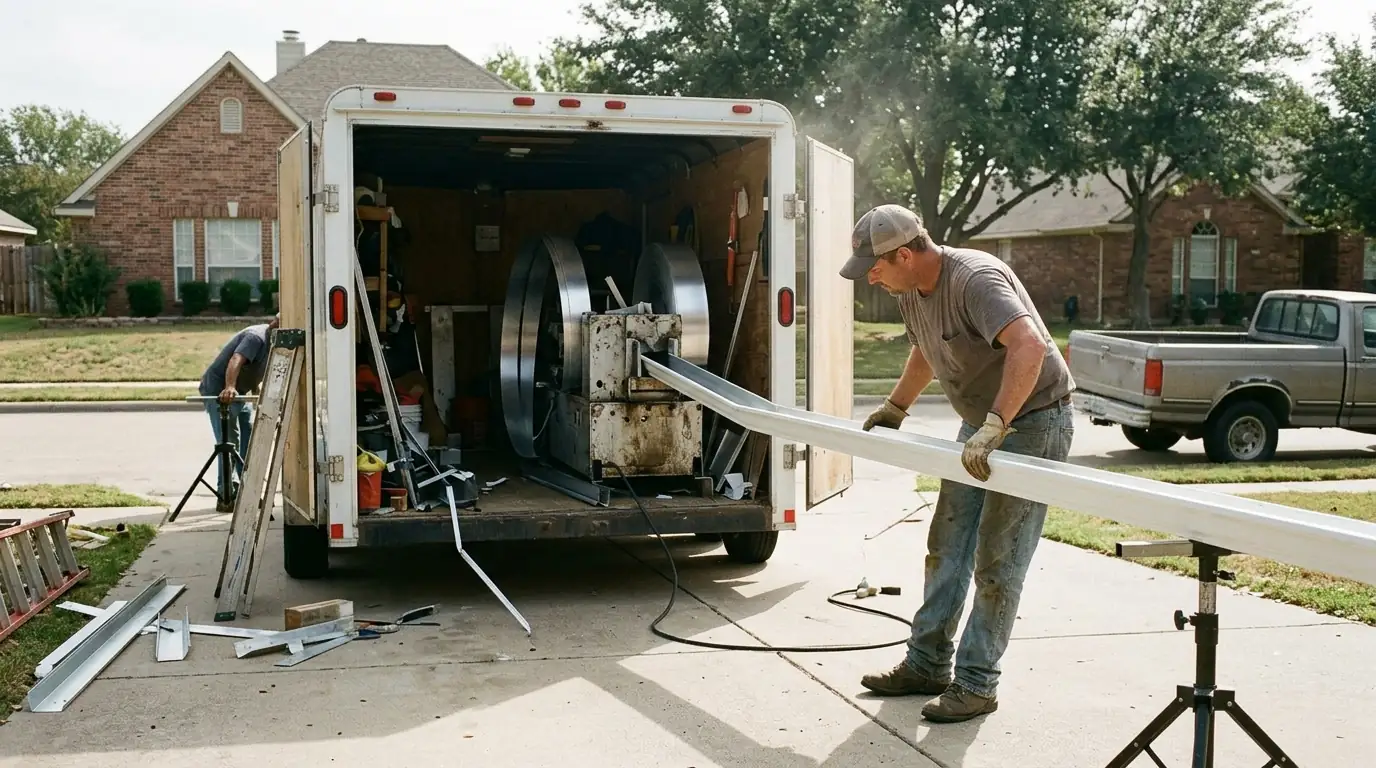
Seamless gutters are formed on site by a machine that bends a flat coil of metal into the gutter profile and cuts it to the exact length of each eave. Dallas suppliers stock seamless coil in aluminum, copper and Galvalume, so the same method works across metals.
Where each one leaks
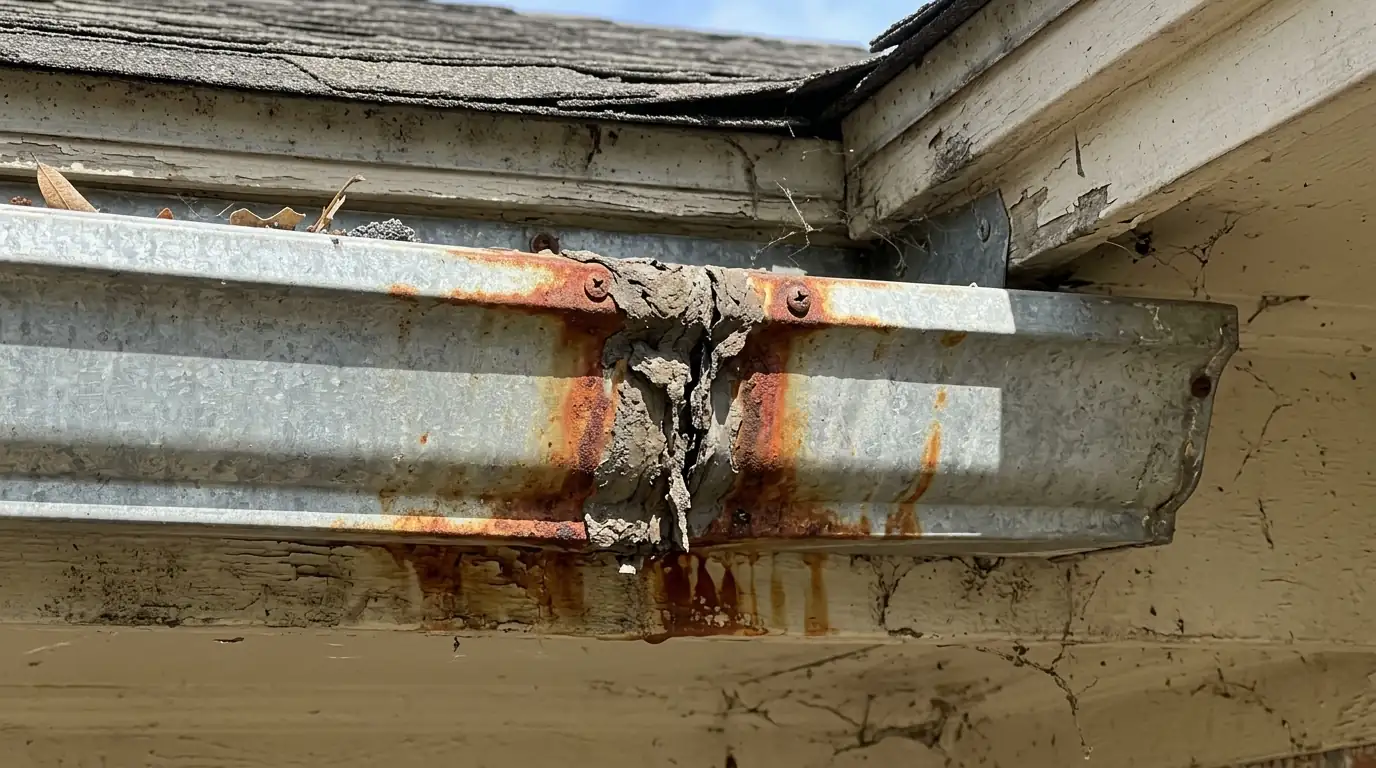
Every joint in a gutter relies on sealant, and sealant ages. On a 40-foot eave, a sectional gutter has several seams along its length plus the corners and ends. A seamless gutter on the same eave has only the corners, end caps and outlet. Fewer joints means fewer places for water to drip behind the fascia or onto a walkway.
Side by side
| Seamless | Sectional | |
|---|---|---|
| Joints | Corners, end caps and outlets only | Every 10 or 20 feet, plus corners and ends |
| Leak risk | Lower | Higher as seams age |
| Who installs | Crew with a forming machine | Often DIY or handyman |
| Upkeep | Clean and check yearly | Reseal seams as they fail |
| Repairs | A damaged run may need a new run | One section can be swapped |
What it costs
National cost guides put installed seamless aluminum at about $10.00 to $15.50 per linear foot, roughly $1.00 more on two-story homes, and list labor alone at about $3 to $10 per foot. Sectional materials look cheaper on the shelf, but once installation and the cost of resealing seams over the years are counted, the gap narrows or reverses.
When sectional still makes sense
- A short run on a shed, porch or outbuilding you will install yourself.
- Patching one section of an existing sectional system that is otherwise sound.
- A tight budget on a house that will be resold soon, with the trade-off understood.
For a main house you plan to keep, seamless is usually the better value.
What to ask any installer
- Will each eave be one continuous run?
- How are corners, end caps and outlets sealed?
- What hangers will hold it, and how far apart?
- Which size, 5-inch or 6-inch, and why?
Switching from sectional to seamless
Moving to seamless is a replacement. The sectional runs come down, the fascia behind them is probed and repaired where soft, and new runs are formed to the length of each eave on site. It is also the moment to fix what the old system got wrong: undersized troughs, too few downspouts, or outlets that empty against the slab. Most single-family homes are done in a day.
- Signs it is time: leaks at several seams, not just one.
- Rust or white oxidation lines below the joints.
- Sections that have separated or sag between connectors.
- Sealant that has been reapplied more than once on the same seams.
Related services we provide
Seamless and sectional gutter questions
Along each run, yes. Corners, end caps and outlets still have joints.
Often a little more upfront, but fewer leaks and less resealing over time.
Yes, though a badly damaged run may be replaced as a new run.
Not bad, just more joints to maintain. They suit small DIY runs and patches.
Sources for this guide
- Seamless gutter costs, RoofingCalc
- Gutter installation cost, Bob Vila
- Seamless gutter coil in Dallas, Service Partners
Figures are national or regional planning numbers from the sources above, not a quote for your home.